
An exercise routine to relieve back pain in pregnancy



Article content
Back pain is the most common complaint during pregnancy. Almost all women experience it at some point during pregnancy, and sometimes it can last a long time and trigger other physical discomfort. To prevent that, I recommend practicing this exercise routine to relieve back pain in pregnancy.
Before we practice, a little theory
To recognize this uncomfortable sensation, you need to know where it is. It usually appears in the upper back, in the sides (due to round ligament syndrome), in the lower back (causing lower back pain), or in the pelvis or buttocks, which is known as lumbopelvic pain. This pain reduces pregnant women’s quality of life and makes it harder for them to keep working during pregnancy.
Around 70% of cases involve pain in the lower back, as it’s the area that changes most during pregnancy. The center of gravity shifts forward (toward the pubis), tilting the pelvis forward (anteversion). This increases the lumbar curve (hyperlordosis) and makes the lower back muscles shorten and tighten.
The pain is described as discomfort in the pelvic girdle, felt over the gluteal fold, around the sacroiliac joints and in the lower spine. As a result, pregnant women find it hard to stand for long periods, they walk more slowly, and even sitting can be uncomfortable. For these reasons, it’s important to do exercises for back pain in pregnancy.
When does back pain appear in pregnant women?
During pregnancy
Back pain, especially in the lower back, can appear around week 18, although it’s most common between weeks 25 and 36. The end of the second trimester is usually when women notice the postural and hormonal changes most and develop lower back pain.
However, the discomfort may appear in the first trimester, which could indicate a more serious spinal or disc problem. When this happens, it’s also usually a strong predictor of pain in the third trimester.
After pregnancy
Almost all women notice an improvement within the first three months after giving birth, and the pain disappears on its own. However, some patients may continue to have moderate or severe pain after pregnancy. These women are at risk of the pain becoming chronic and need help from a physiotherapist specializing in postpartum treatment.
As well as professional help, many people look for tools to help ease muscle tension and support recovery, such as Magnetic-Tape, to modulate the perception of pain and encourage muscle activation without medication, which can complement the physical care routine we suggest below.
Another recommendation for after pregnancy is to switch to a menstrual cup, if you don’t already use one. I use Beppy Cup, and I’ve written this article answering all your questions about using a menstrual cup after giving birth.

What causes back pain in pregnancy?
The causes of this condition aren’t entirely clear, but we do know that there’s no single factor: its origin is multifactorial. That’s why it’s important to give patients information about the changes their body goes through during pregnancy, the influence of hormones on bone structures and the changes in how the muscles work.
This way, the pregnant woman can better understand why good physical preparation for birth matters. In other words, she’ll understand how important it is to do back exercises during pregnancy and will train properly throughout, helping prevent the pain or delay its onset.
The best-known causes of back pain in pregnant women are:
Hypermobility
This means having too much movement in the joints, especially in the spine and pelvis. The hormone relaxin, produced by the pregnant woman’s body, loosens the ligaments of the pelvis.
On the one hand, relaxin is a hormone needed for pregnancy and birth; on the other, it can cause excessive loosening of the sacroiliac joints, separation of the pubic symphysis and lower back pain. To counter this, exercises for pregnant women with back pain are needed to reduce these effects.
Postural changes
As the baby grows and pregnancy progresses, the lumbar curve and thoracic kyphosis increase. It’s common to see pregnant women with rounded shoulders and a sunken chest.
Abnormal muscle activation patterns
Loss of strength in the abdominal wall muscles and reduced function, overloaded lower back muscles and hypertonia of the glutes (increased tension in the buttocks).
The influence of fear of pain
It isn’t helpful for pregnant women to be afraid of feeling pain. It may sound like a play on words, but many women are very worried that moving and doing back pain exercises during pregnancy could cause an injury. In other words, they fear that physical activity could cause pain.
That’s why, when the pain is very intense, gentle exercises are needed, as moderate exercises could make the pain feel worse and lead to rejection. This must be avoided so the patient is encouraged to keep doing exercises for back pain during pregnancy.
These worries about pain increase pregnant women’s disability. So, when starting physical activity, it’s essential to have an initial assessment and get information about the condition of the spine and muscles. The aim of this assessment is to choose the most suitable exercises for back pain during pregnancy.
How often should you do exercises for back pain in pregnancy?
To notice relief, you need to train 3 times a week. But if you already do other activities, such as prenatal Pilates classes led by a professional, the intensity will probably be higher and this routine could be reduced to 1 or 2 sessions a week.
That would be enough to prevent and/or reduce back pain and prepare better for the birth. And if you use a pelvic support belt, the pain will be less and your sense of well-being will increase.
Remember that the right pelvic belt depends on your size. There are pelvic belts for sizes above 40 (US 10) and belts for sizes below 40.
Exercises to relieve back pain in pregnancy
The effectiveness of exercise in treating or preventing back pain has been shown in medical studies: women who do exercise programs designed by a professional have less pain.
When is the best time to start back exercises in pregnancy, and what’s the goal?
The best time to start physical activity is in the second trimester, around week 18–20 of pregnancy. The goal of training for a pregnant woman with back pain is to improve the strength and tone of the transverse abdominis, a muscle that stabilizes the pelvis and spine.
When doing exercises to relieve back pain in pregnancy, we look for positions that activate this muscle correctly (lying on your back, on all fours or lying on your side) and use extra equipment (Pilates balls, rings or resistance bands) to make them more effective.
Stretching the muscles at the back of the body (glutes, lower back, side trunk muscles or hamstrings) is also very helpful in preventing or treating back pain.
So the training routine should include toning exercises for the transverse abdominis, pelvic floor and stabilizing muscles, combined with stretches for the back of the body.
Here are the exercises I suggest to relieve back pain in pregnancy:
-
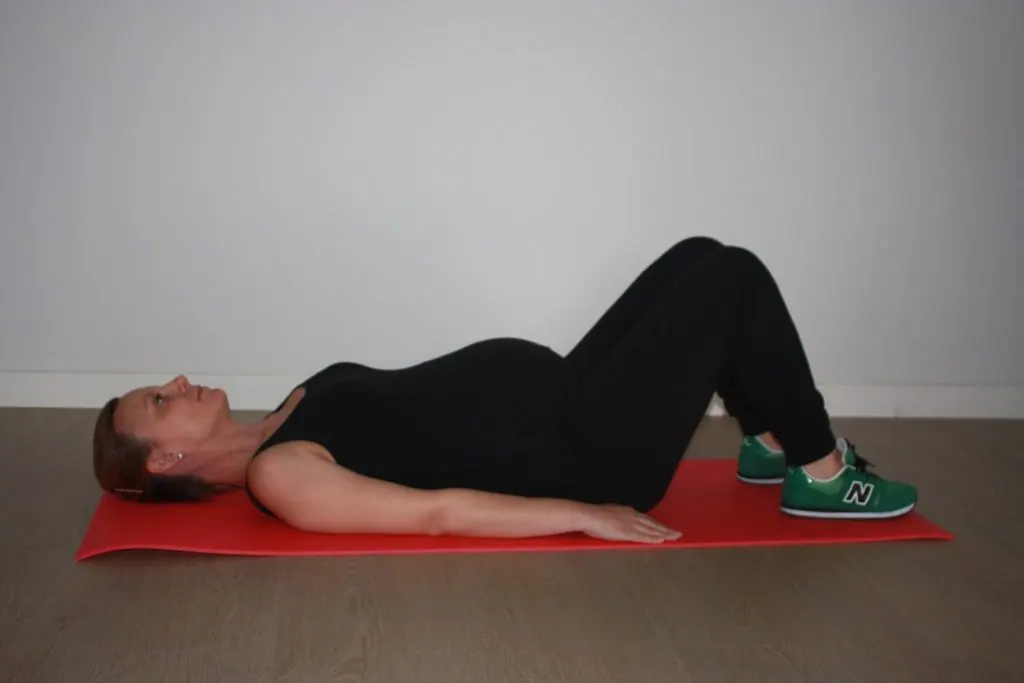
Activating the transverse abdominis and pelvic floor in neutral
- Lying on your back with your legs bent, place your pelvis and spine in a neutral position.
- Your lower back should neither press into the floor nor arch. Keep the natural lumbar curve, without reducing or increasing it.
- The correct pelvic position means keeping your pubic bone and hip bones on the same plane. If you place your hands on your pubic bone and hips, they should form a completely flat triangle, parallel to the floor.
- Breathe in deeply through your nose, sending the air to your sides.
- Breathe out through your mouth and activate your deep trunk muscles: close your ribs, draw your belly button toward your lower spine (inward, as if you wanted to flatten your abdomen) and close your sphincters.
- Do this exercise to relieve back pain in pregnancy while keeping your pelvis and spine in neutral.
- Remember that it’s a muscle activation with no movement of the trunk.
- Repeat 10 times.
- This picture shows how to contract the transverse abdominis and pelvic floor.
-
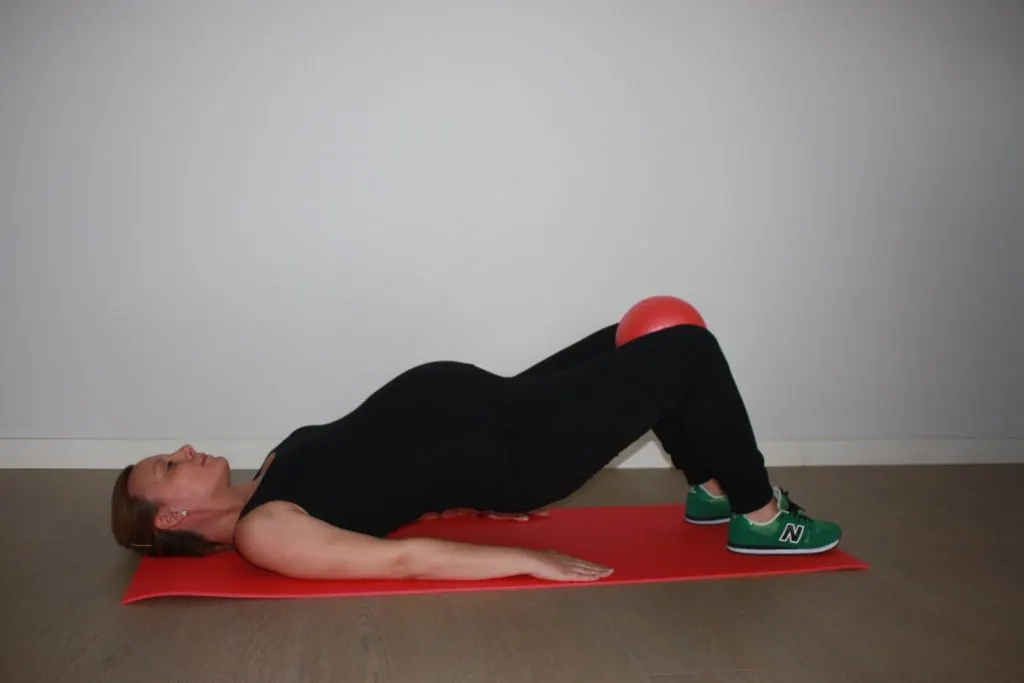
Shoulder bridge with a small ball
- Lying on your back with your legs bent, place a small ball or soft ball between your knees. In the starting position, remember to place your pelvis and spine in neutral.
- Breathe in deeply, sending the air to your sides.
- As you breathe out, squeeze the ball to activate your adductors and pelvic floor, and lift your lower and upper back one vertebra at a time (up to the tips of your shoulder blades).
- Stay up, aligning your knees, hips and shoulders in a diagonal.
- Breathe in with your trunk raised and, as you breathe out, squeeze the ball again and lower your spine and pelvis to the mat one vertebra at a time.
- Remember to lift your spine “bone by bone” so the deep abdominal muscles can activate. It isn’t about going up and down quickly without purpose. This exercise is very good for stretching the back muscles and toning the abdominal and pelvic floor muscles.
- Repeat 10 times.
-
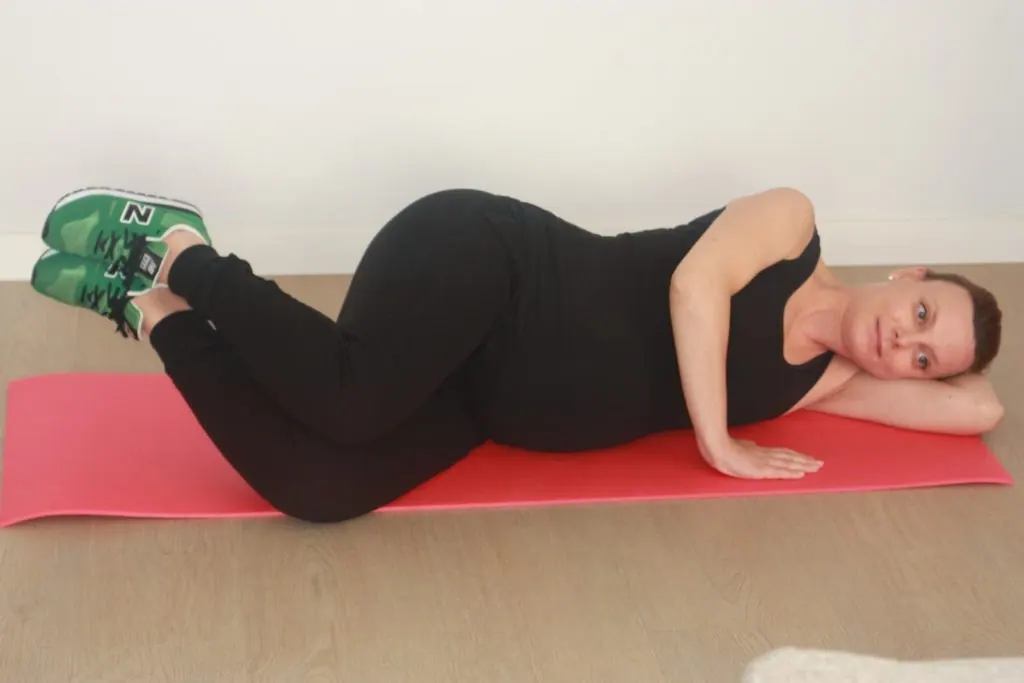
Ankle lifts
- For this exercise, lie on your side with your legs bent and place your pelvis in neutral. In this position, neutral means keeping both hips at the same height (right hip directly over left hip).
- Rest your top hand on the floor for more stability and so you don’t strain your neck.
- Breathe in deeply and, as you breathe out, activate your transverse abdominis (drawing your belly button in and closing your rib cage) while lifting your feet. The idea is to lift your lower legs while keeping your knees on the floor. This movement activates the glutes and lower back muscles and tones the parts of the body that are weakest during pregnancy.
- Repeat 10 times.
-
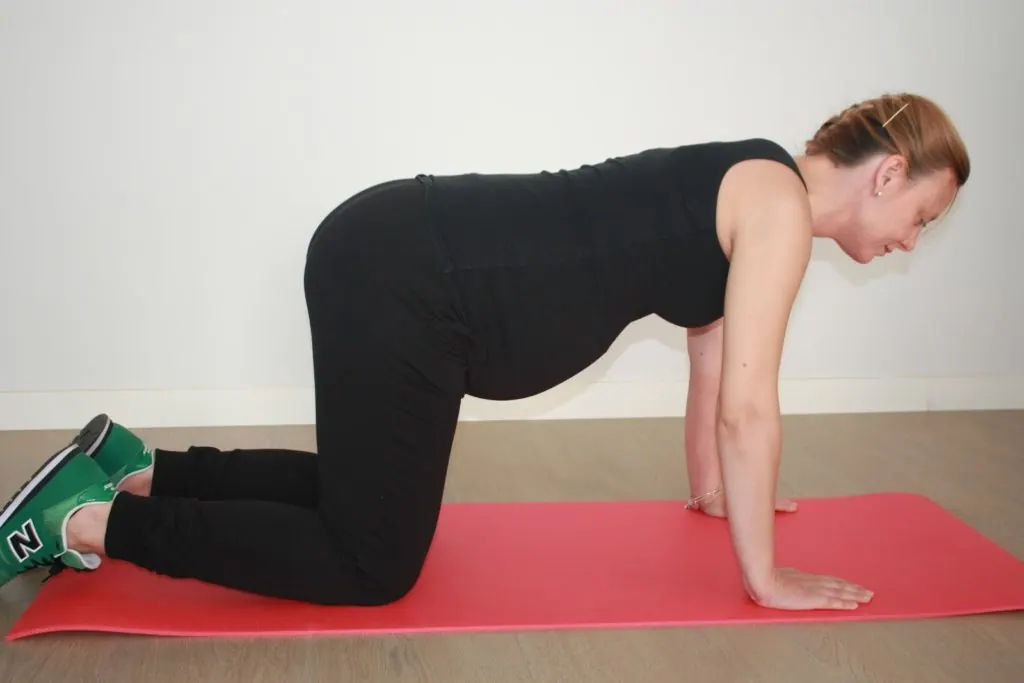
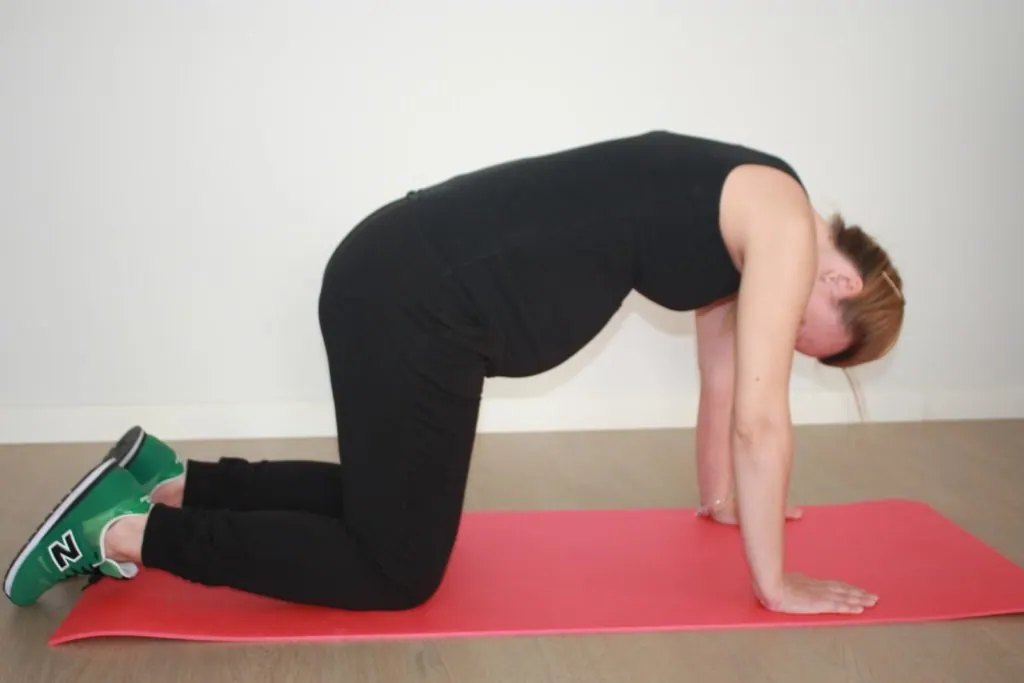
The cat
- On all fours, place your knees under your hips and your hands under your shoulders. Keep your head in line with your spine.
- Breathe in deeply, expanding your rib cage and, as you breathe out, activate your transverse abdominis and push your spine toward the ceiling.
- Round your back, lifting your upper spine to form the shape of an angry cat.
- Breathing in, return to the starting position.
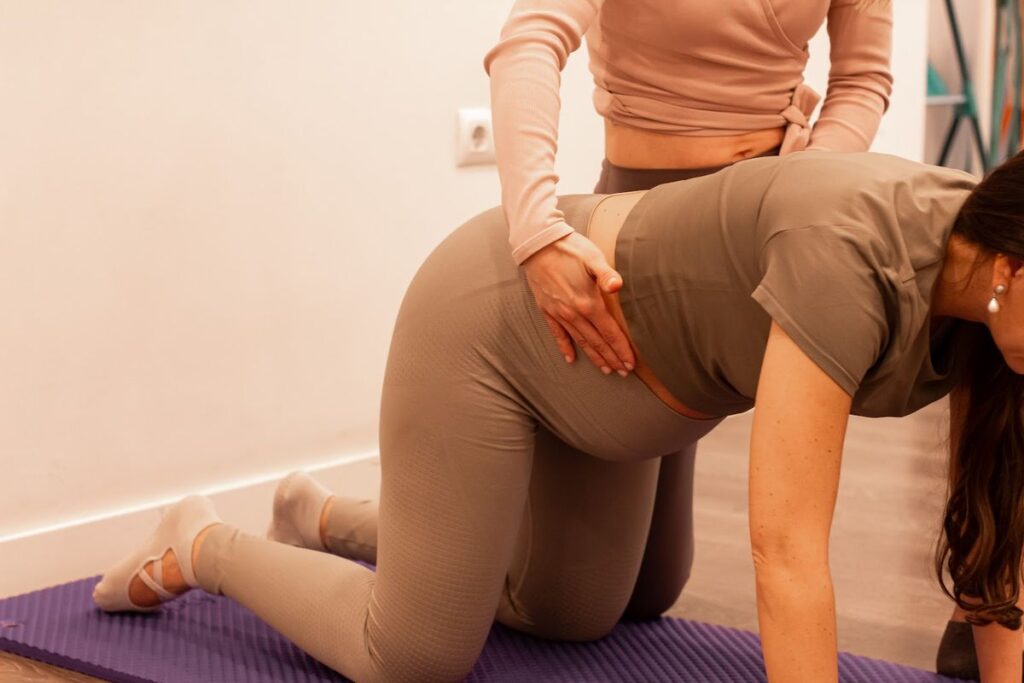
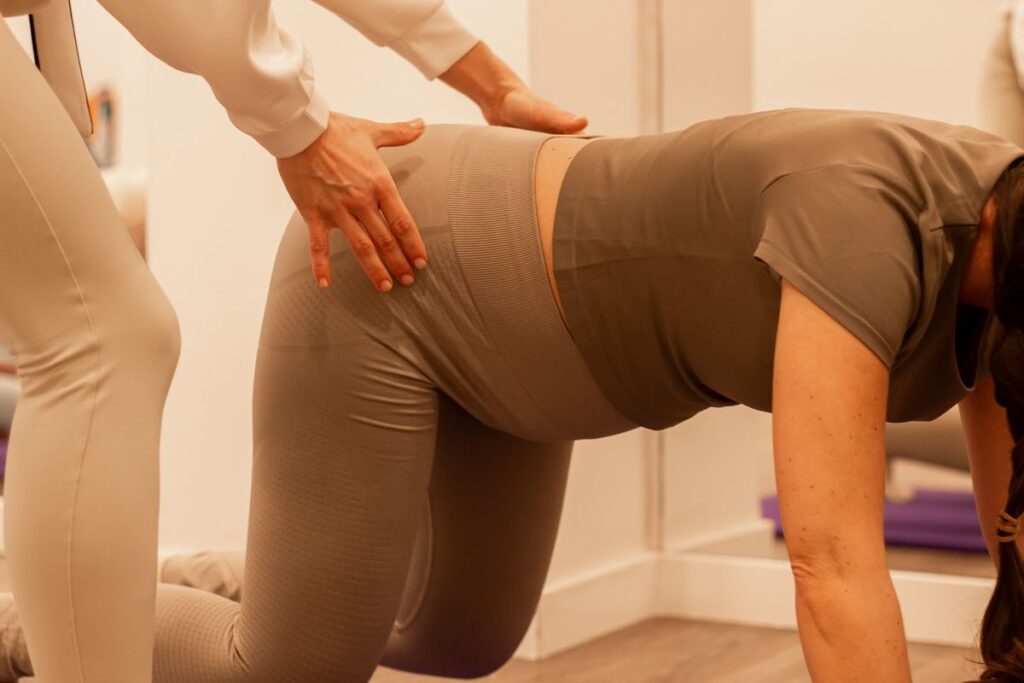
Bear in mind that, in this exercise to relieve back pain in pregnancy, the second part of the usual exercise, arching the spine by dropping the lower back, is not recommended, as it could increase the pregnant woman’s pain.
So here’s the modified version, as in the photos: starting position with a neutral spine, stretching “the spine upward,” and back to neutral again.
-
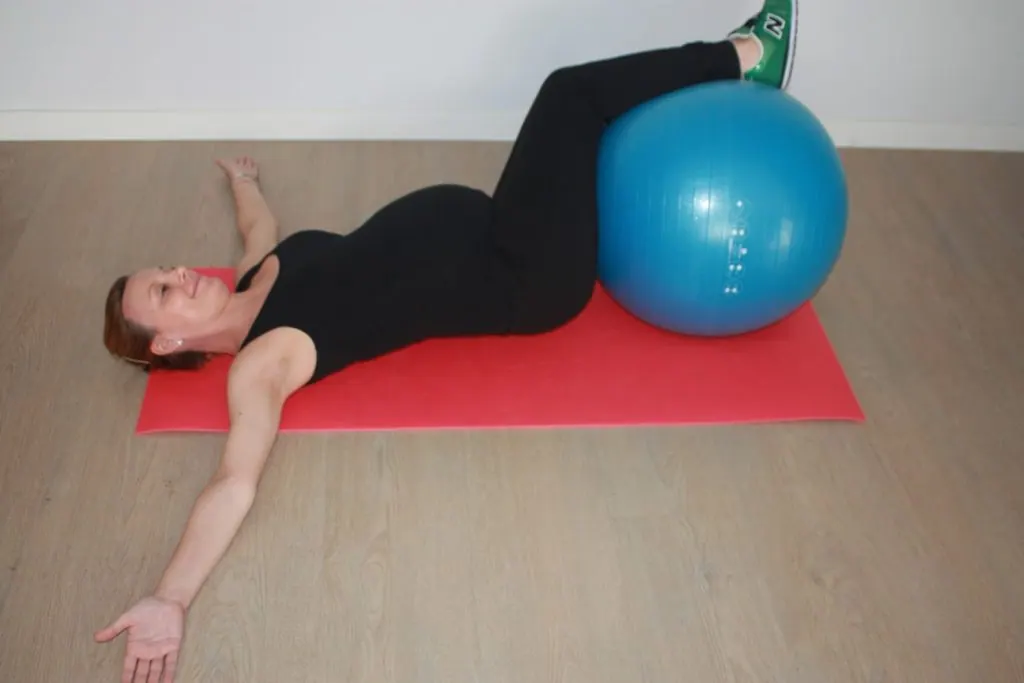
Spine and trunk rotation with the fitball
- Lying on your back, rest your legs (bent at the knees) on the fitball for pregnant women.
- Open your arms out to the sides, keeping your wrists in line with your shoulders.
- As you breathe in, let the ball and your legs drop to one side (rotating your pelvis and spine) and, as you breathe out, activate your transverse abdominis and return to the center.
- Switch sides and repeat 10 times to each side.
- Remember to stabilize your upper trunk and keep your shoulders on the floor at all times, so they don’t lift as you turn your hips.
-
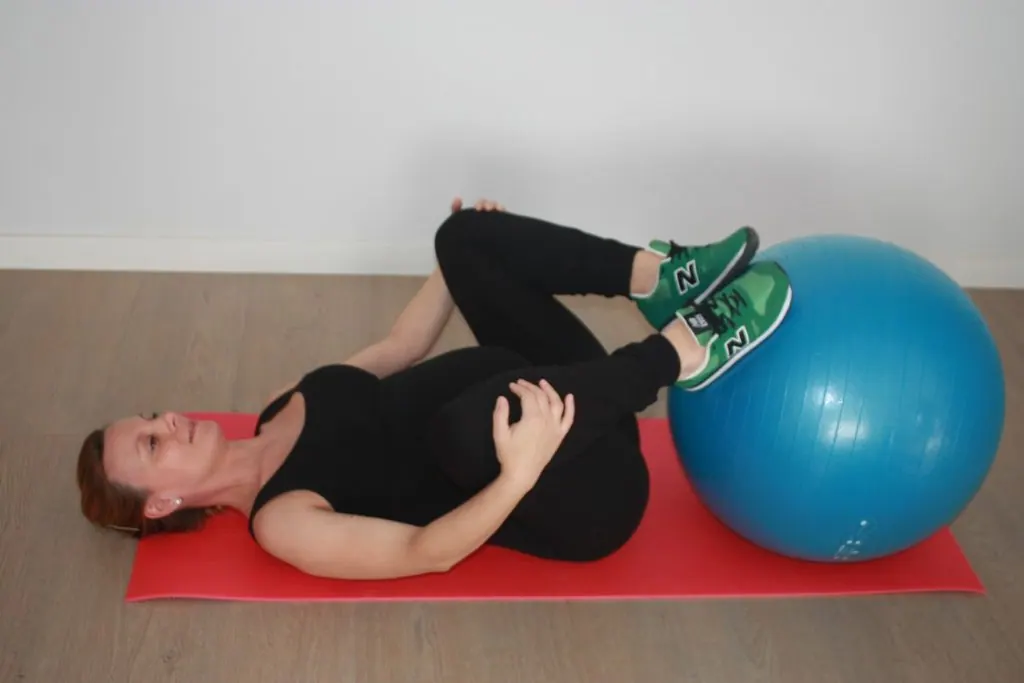
Glute and lower back stretch
- Lying on your back with your legs raised, rest your feet on the large fitball.
- Move your knees apart to make room for your bump.
- This back exercise for pregnant women involves drawing your knees (with your hands) toward your chest and holding the position for a few minutes (8–10 breaths).
- This position stretches all the muscles at the back of the pelvis, the glutes, the sacrum and the lower back.
- You can add a gentle side-to-side rocking of the trunk to massage your lower back and sacrum. You’ll feel great relief and rest.
The best way to keep your cardiovascular system in good shape and your musculoskeletal system strong and free of tension is to combine this toning routine with Pilates and some aerobic activity, such as swimming, a stationary bike or walking.
In short, here’s a Pilates exercise routine to relieve back pain in pregnancy, ideal to start practicing in the second and third trimesters. For it to be more effective, I recommend seeing a physiotherapist specializing in obstetrics and the pelvic floor who can help you plan a personalized routine adapted to your specific problem.
Below is a demonstration video with toning exercises designed specifically to relieve back pain during pregnancy. These easy-to-follow, safe exercises will help you stay active and comfortable during this very special time.


Prepare for your birth at our clinic in Valencia
We support you throughout your pregnancy with physiotherapy for pregnant women, adapted to each trimester and your situation. Can’t come to Valencia? We also see patients in an online consultation.