




Physiotherapy for lower back pain in Valencia
When your lower back won’t give you a break, it’s worth looking beyond your back. We assess your back, pelvis and pelvic floor to tailor treatment to you.



Article content
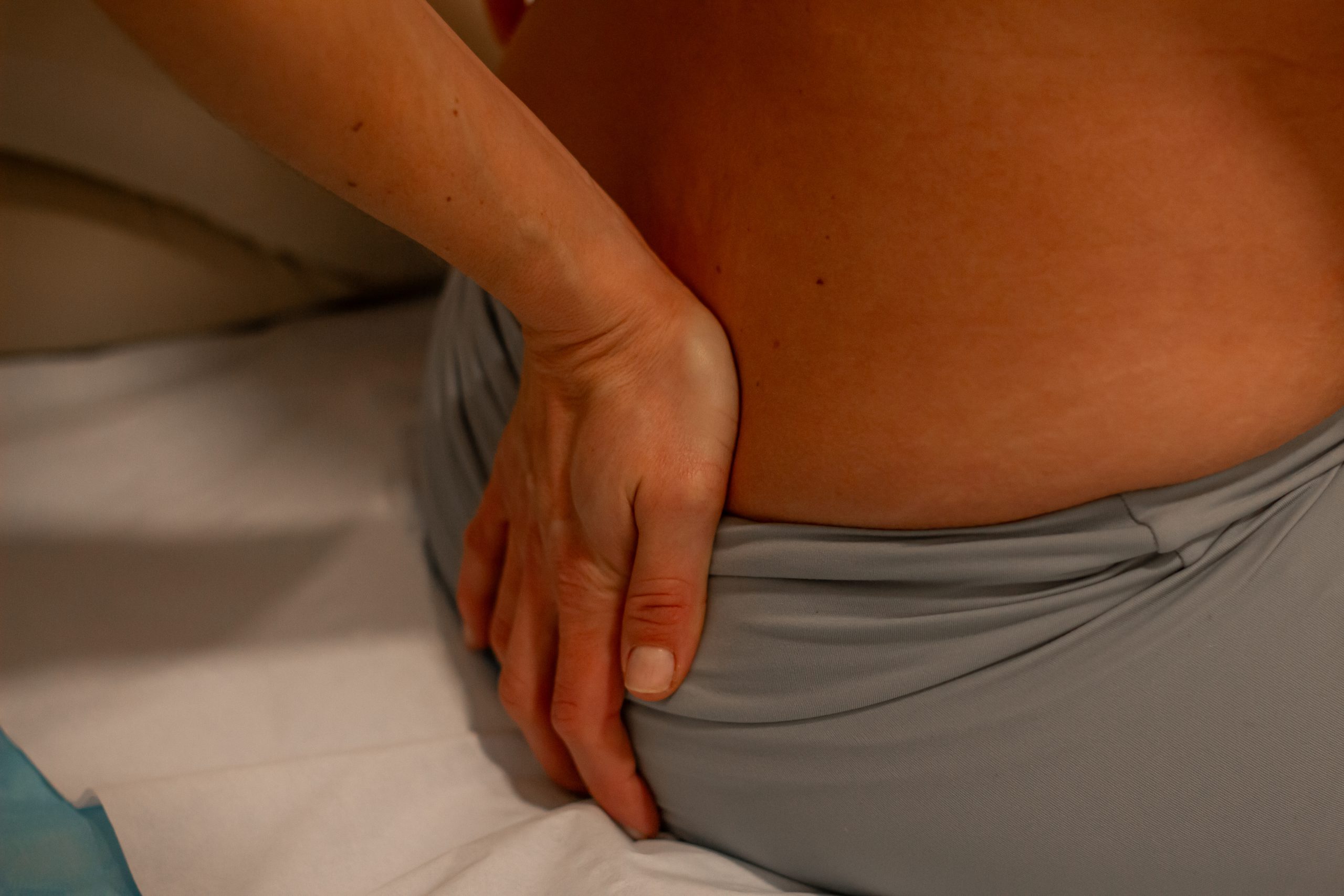
Lower back pain in women
If you’ve had lower back pain for a while and feel that nothing quite works, perhaps the pelvis and pelvic floor haven’t been looked at. They are closely linked, and understanding this is often the first relief.
Lower back pain is felt in the lower part of the spine, below the ribs and above the buttocks. Sometimes it stays in the area of the sacrum and buttocks, and at other times it spreads towards the pubis or down the back of the leg, which is known as sciatica.
The most common complaints are:
- Deep pain in the lower back, on one or both sides.
- Pain in the buttocks and sacrum, which can reach the back of the thigh.
- Difficulty changing position, twisting the trunk or moving from one movement to another.
- Difficulty bending down to pick up the shopping, lifting something off the floor or getting out of bed.
The most common cause is overload of the lower back muscles. The pelvic floor, transverse abdominis, deep back muscles and diaphragm form a unit that stabilizes the spine and pelvis every time you lift something, cough or walk. When one of them weakens, the others do extra work and become overloaded. That’s why, if lower back pain persists, it’s worth assessing the pelvic floor too, especially if you also leak urine. At other times the pain is caused by a disc problem, such as a bulge or a herniation, which your doctor should investigate.

In pregnancy, postpartum and beyond
Lower back pain is very common during pregnancy. According to a Cochrane review, more than two thirds of pregnant women have lower back pain and almost one in five have pelvic pain, and both tend to increase as pregnancy progresses (Liddle and Pennick, 2015). Contributing factors include the shift in the center of gravity, which increases the lumbar curve, relaxin, which makes the pelvic ligaments looser, and loss of strength in the abdominal wall.
In many women the pain improves in the months after the birth. If it continues, it’s worth assessing it together with the pelvic floor, the abdomen and any cesarean or episiotomy scar.
Outside these stages we also treat lower back pain linked to work involving lifting, a sedentary lifestyle, chronic constipation or abdominal or pelvic surgery, such as a hysterectomy.

“If lower back pain persists, it's worth assessing the pelvic floor too”

How we treat lower back pain

Therapeutic massage of the lower back, glutes and legs, myofascial techniques, mobilization of the spine and pelvis and passive stretching. We always combine it with exercise.
Exercises for the transverse abdominis, pelvic floor and trunk-stabilizing muscles, stretches for the back of the body and proprioceptive exercises to improve your everyday posture.
We apply kinesiology tape to support the rest of the treatment when we see it is indicated in your case.
Intercostal and diaphragmatic breathing exercises and relaxation of the diaphragm. The diaphragm is part of the muscle unit that stabilizes the spine, and tension in it is linked to discomfort in the upper and lower back.
If the assessment indicates it, we work on the pelvic floor and abdomen with Kegel exercises, hypopressive abdominal exercises outside pregnancy and adapted Pilates with a lengthened spine.
Article content
When to see your doctor first
Physiotherapy does not replace a medical consultation. Make an appointment with your primary care doctor if the pain doesn’t improve after a few weeks of self-care at home, if it stops you going about your daily life, if it gets worse at night or isn’t relieved by rest, if it increases when you cough, sneeze or open your bowels, or if it comes with unexplained weight loss or a lump on your back.
Go to the ER or call 112 if your lower back pain comes with any of these signs:
- Tingling, weakness or loss of sensation in both legs.
- Loss of sensation around the genitals or anus.
- Difficulty urinating, or leakage of urine or stools you can’t control.
- Chest pain, or pain that started after an accident or a hard blow.
If you’re pregnant, call your midwife or gynecologist, or go to the maternity emergency department, if your back pain comes with fever, vaginal bleeding or pain when urinating, if you have pain in your side below the ribs, or if you’re in the second or third trimester and aren’t sure whether it could be a sign of labor.
What we do in clinic
We start with a physiotherapy assessment. We examine the pelvis, the lumbar region, the strength and tone of the abdominal muscles and the diaphragm. If it makes sense in your case, and always with your consent, we also assess the pelvic floor vaginally to check the quality of the contraction and whether there is any prolapse.
With that information we decide which combination of manual therapy, exercise and postural re-education suits you, and give you exercises for home. If you’re pregnant, the exercises are adapted to each trimester and only done if your gynecologist hasn’t advised against them. If anything we find needs medical investigation, we tell you and refer you.


What do we work on in physiotherapy for lower back pain?
Exercise is the foundation of the work. In pregnancy, a Cochrane review found that exercise can reduce lower back pain and improve the ability to do daily tasks, with low- to moderate-quality evidence (Liddle and Pennick, 2015). Outside pregnancy, the NICE guideline on low back pain recommends exercise and considers manual therapy only as part of a treatment package that includes exercise (NG59, updated in 2026).
That’s why we combine manual therapy with exercises for the deep abdominal muscles, the pelvic floor and the trunk-stabilizing muscles, together with stretches for the lower back, glutes and the backs of the legs.
The goal is for you to move more freely day to day and to know which exercises to do at home and how to adapt them to your stage of life. The exercises are chosen at the assessment and adjusted according to how you respond.
Mobility of the lower spine and pelvis in everyday movements.
Overloaded lower back muscles, with manual therapy and stretching.
The deep abdominal muscles and the pelvic floor, which support the spine.
Posture and breathing adapted to your stage, whether pregnancy, postpartum or any other.



Your journey at the clinic starts like this
STEP 1.
Initial assessment
All patients start with an initial one-to-one session.
- We analyze your case in depth.
- We carry out the necessary examination.
- We explain what is happening and why.
- We design a personalized treatment plan.
- All with no further commitment.
STEP 2.
STEP 3.
Follow-up and progress
Your process doesn’t end after one session. It evolves with you.
- We regularly reassess your progress.
- We adjust the plan when necessary.
- You can combine one-to-one and group sessions depending on your progress.


Frequently asked questions
If you’re asking yourself these questions, you’re not the only one. Here we answer them clearly.
It’s very common. More than two thirds of pregnant women have it, and it usually increases as pregnancy progresses. Being common doesn’t mean you have to just put up with it. Adapted exercise and physiotherapy can help, and if the pain comes with fever, bleeding or pain when urinating, call your midwife or gynecologist.
The pelvic floor works as a team with the transverse abdominis, the deep back muscles and the diaphragm to stabilize the spine and pelvis. If one part of that unit isn’t doing its job properly, the rest become overloaded, and the lower back is one of the areas that notices it most. That’s why we also look at the pelvic floor at the assessment.
Yes, gentle mobility exercises, stretches and transverse abdominis activation usually work well, and in pregnancy as long as your gynecologist hasn’t advised against them. Hypopressives are not practiced during pregnancy, and planks are not advisable if you’re pregnant or have abdominal diastasis. If the pain doesn’t improve with the exercises, ask for an assessment.
It’s a physiotherapy assessment. We ask about your pain and your history and examine the pelvis, lower back, abdomen and, if it makes sense and you agree, the pelvic floor. With that we decide the treatment plan, and if anything needs medical investigation we refer you.
In many women lower back pain improves in the months after the birth, but not in all. If it continues, it’s worth having it assessed by a physiotherapist specializing in postpartum, who will also check your pelvic floor, abdomen and any cesarean or episiotomy scar. From there, treatment is tailored to you.
It depends on each patient: your starting point, whether there is a deeper injury or condition, and how committed you are to the exercises at home. After the first session we decide on the right treatment. If you need individual follow-up, most people notice an improvement with a first pack of 5 sessions. From there, if you follow the guidelines at home, you may only need to come back for occasional check-ups. If there is a deeper injury, you may need to go beyond that first pack.