How to exercise your pelvis in pregnancy and help your baby get into a good position for birth



Article content
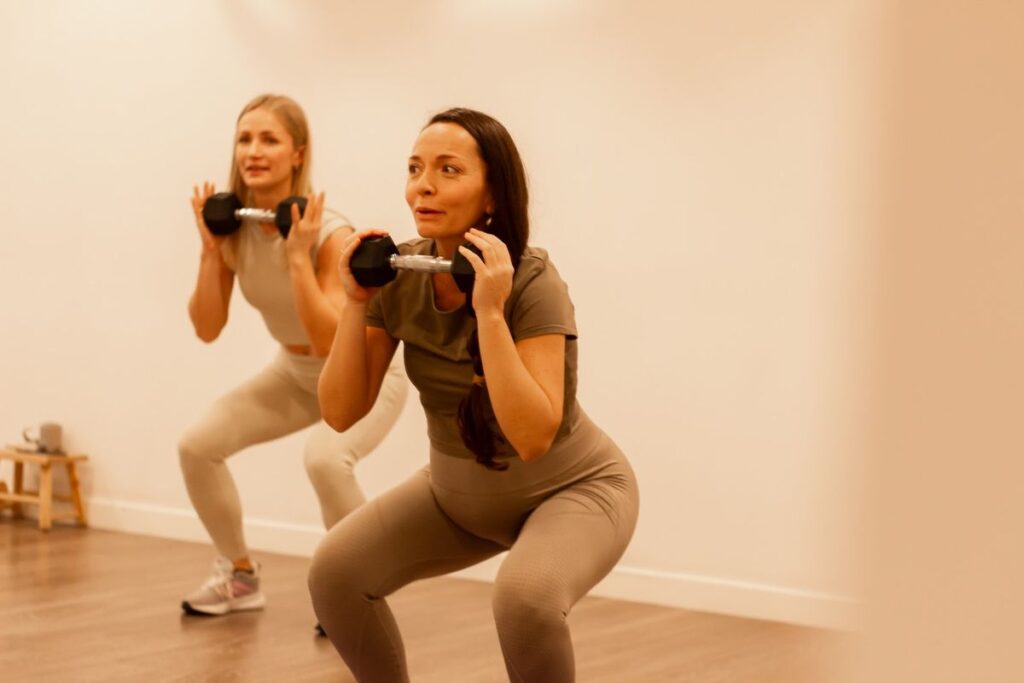
In my appointments with patients and in the talks I take part in, I like to compare vaginal birth to running a marathon. Common sense tells us we wouldn’t show up at the start of a 26-mile (42 km) race without having prepared physically and mentally first, right? The same goes for birth, which requires prior work combining exercise, nutrition and mental training so you’re in shape when you give birth.
I don’t mean that you have to be a pregnant woman with a six-pack, but I do want you to be aware of how important the physical and mental work required for pregnancy and birth is, so that each woman, at her own level, reaches the best possible fitness.
That’s why in this post I’m going to focus on one of the most important parts of the body for vaginal birth: the pelvis. I’ll explain exercises to mobilize the pelvis during pregnancy and the aim of this training for vaginal birth.
Why are pelvic mobility exercises so important during pregnancy?
In the days before birth, the last ultrasound or check-up with the midwife confirms the baby’s position in relation to the mother’s pelvis. According to many studies, the most favorable position for a birth without complications is the occiput anterior position.
In this position, the baby is placed with its head down, its face toward the mother’s sacrum and its back and spine toward the mother’s belly. We can say that in this position the baby is looking toward the back of its mom’s pelvis.
This is the position that allows the best descent toward the cervix, as the baby can tuck its head toward its chin and present the smallest part of the crown at the perineum during the pushing stage. Having a pelvis free of tension and doing exercises that help the baby engage is very beneficial for the pregnant woman, as it can prevent a prolonged labor or one with complications, such as the use of instruments.
When should we start doing pelvic mobility exercises?
There’s no need to do them from the start of pregnancy to achieve the optimal fetal position, as the baby will move a lot throughout the second and third trimesters. In the home stretch, from week 34–35, is a good time to start this type of training.
If the baby is already in the right position, these exercises can “encourage” it to start descending into the birth canal. And, on the other hand, if our baby is in the occiput posterior position (less favorable for birth), the right mobility training and good posture can increase the chance that it turns and settles into the optimal position.
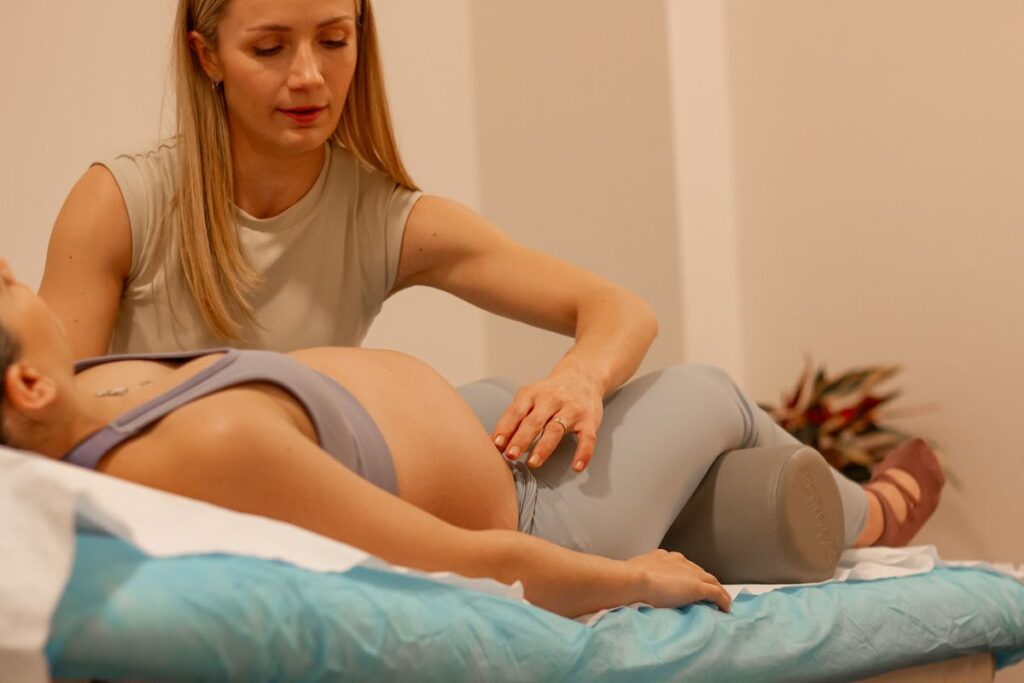
Some pregnant women have back pain during pregnancy before week 34, such as lower back pain, sciatica or pubic pain… that keeps them from living normally. In this case, it will be necessary to start pelvic mobility exercises as soon as possible, together with specific urogynecological physiotherapy treatment. In addition, to ease muscle pain or lumbopelvic tension, Magnetic-Tape can help modulate the perception of pain and improve muscle recovery after physical activity.
7 pelvic mobility exercises for a good birth
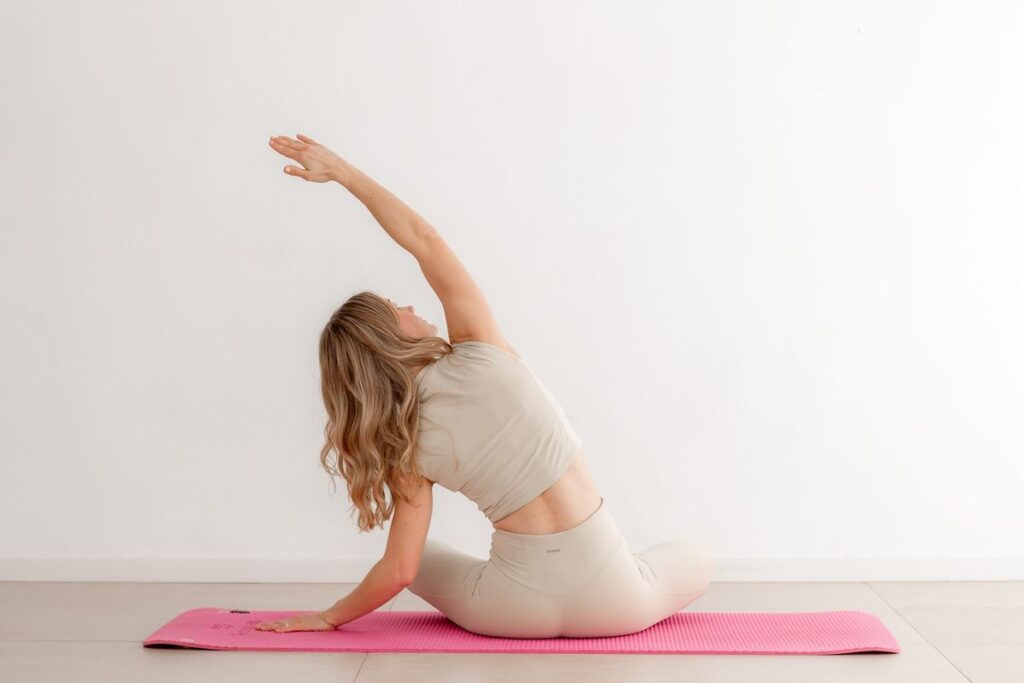
Here are exercises that help release tension in the lower back and pelvis and help the baby get into the right position before birth.
-
Dynamic psoas stretch.
A tight psoas (hip flexor) limits the mobility of the lumbar spine, pelvis and hip. This could reduce our ability to adopt physiological positions during a vaginal birth. In addition, a shortened psoas reduces blood flow and nerve supply to the uterus, which could make contractions feel more painful.
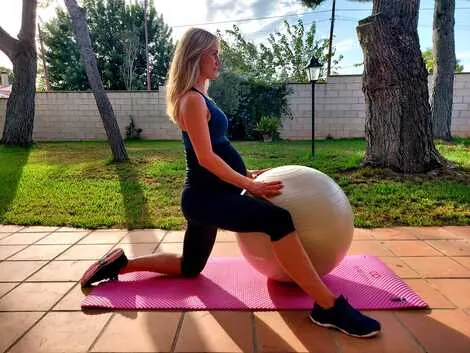
Kneel on the mat and put one leg forward, with the foot in front of the knee. You can use the Pilates ball for support. Keep your spine lengthened.
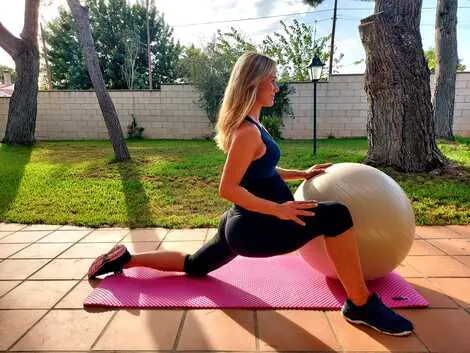
As you breathe out, let your body weight shift forward (toward the front leg) until you feel an intense stretch in the groin and the front of the thigh of the back leg.
Do 10 movements on each side, coordinated with your breathing.
-
Mobility exercise for the mid-pelvis.
The aim of this exercise is to increase the elasticity of the adductors (the inner thighs), which will indirectly improve the flexibility of the pelvic floor. In addition, the sideways movement with the legs in an asymmetrical position increases the diameter of the mid-pelvis (the area the baby’s head passes through just before the pushing stage).
By the way, good pelvic floor control during pregnancy not only helps prevent problems such as incontinence, it also makes it easier to use more advanced and comfortable solutions during your period later on, such as menstrual cups (which I always take the chance to recommend to my patients).
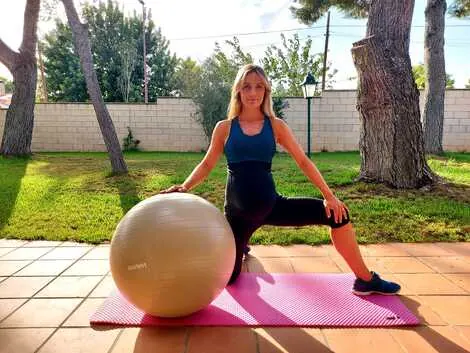
Kneel and open your left leg out to the side. Your shoulders and hips should be aligned (facing forward).
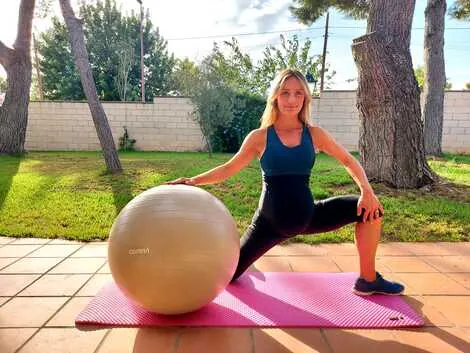
As you breathe out, let your body weight shift toward your left leg (sideways) until you feel an intense stretch in the inner thighs of both legs. You can use the fitball for support.
Do 10 movements with each leg, coordinated with your breathing.
-
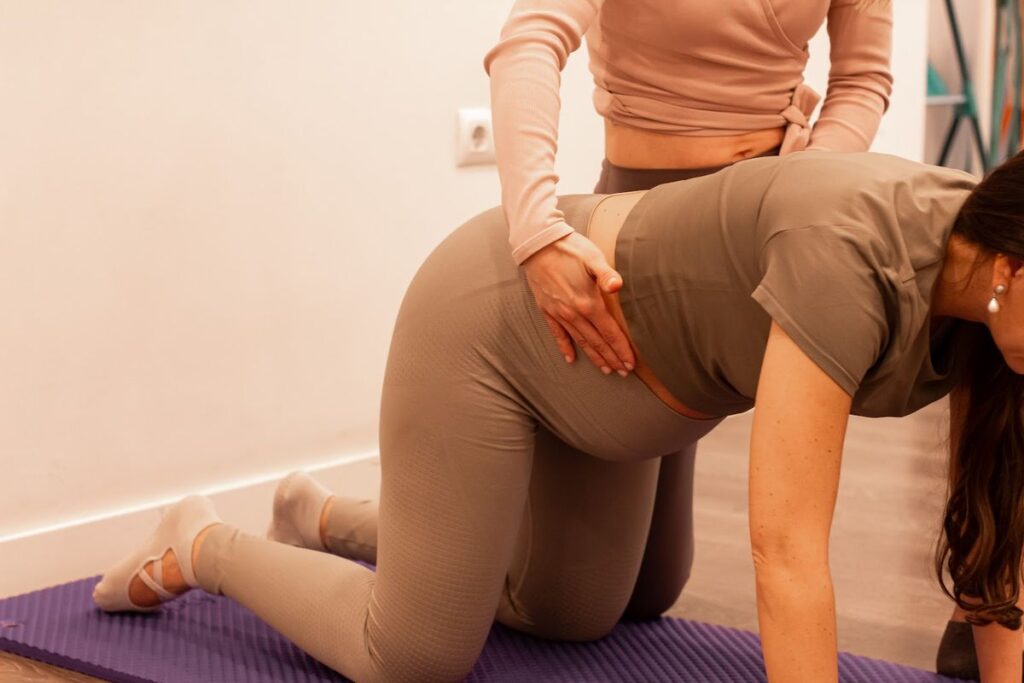
Upper pelvis mobility exercise on all fours.
This exercise helps open the upper pelvis (the area between the iliac bones) and, at the same time, encourages the baby into the occiput anterior position. The heaviest part of the baby’s body is its back, so when we’re on all fours, gravity guides the fetus into the right position (its back toward the mother’s belly and its face toward her sacrum).
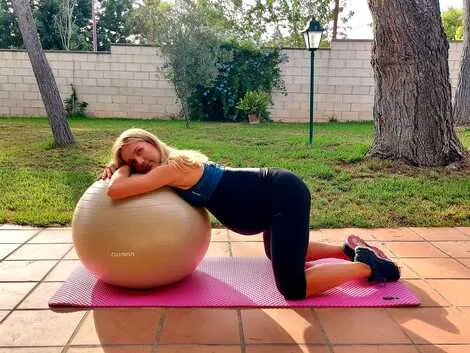
Starting position: on all fours, rest your trunk on the fitball, with your knees hip-width apart.
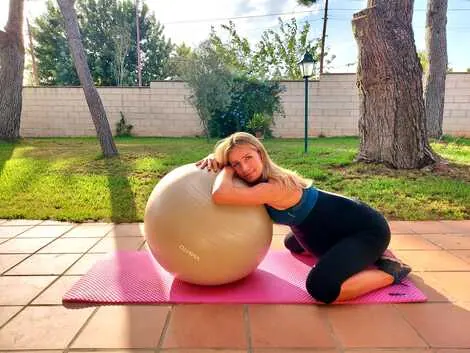
As you breathe out, let your body weight shift back until your buttocks rest on your heels. As you breathe in, come back up.
Do 10 to 20 dynamic movements, raising and lowering your hips in time with your breathing.
-
External and internal hip rotations.
The aim of this exercise is to mobilize the hip joints and at the same time change the space in the upper and lower pelvis. If we open our knees outward, our hips also open (external rotation) and the upper diameter of the pelvis increases. If we bring our knees inward (feet outward), our hips rotate inward (internal rotation) and the diameter of the lower pelvis increases. These two positions are crucial during birth: external hip rotation during dilation and internal rotation during pushing. In addition, the all-fours position helps the baby engage in the occiput anterior position.
Get on all fours and rest your trunk on the fitball. First do external hip rotation, opening your knees slightly and bringing your feet together.
Then do internal hip rotation, opening your feet out to the sides as far as you can, as in the second image.
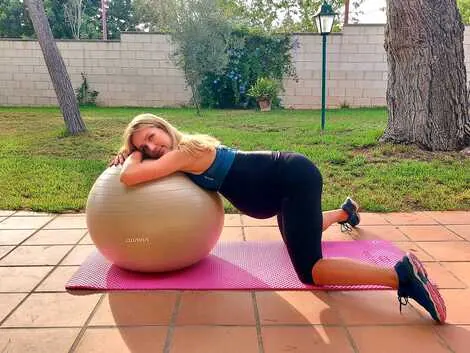
Do 10 to 20 rhythmic, wide movements bringing your ankles together and apart.
-
Pelvic movements sitting on the fitball.
Moving the pelvis while sitting on the Pilates ball releases tension in the lower back and increases pelvic mobility.
Usually about 8–10 repetitions of different movements are done, such as hip circles, side-to-side movements, rocking forward and back, small bounces, and circles with the legs in an asymmetrical position.
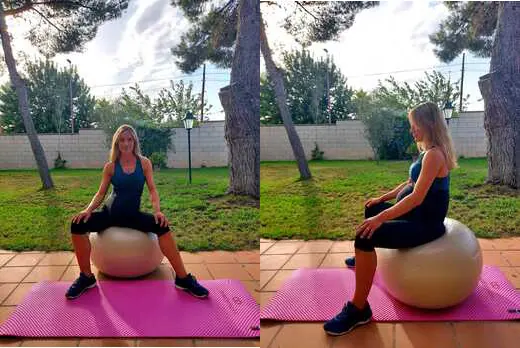
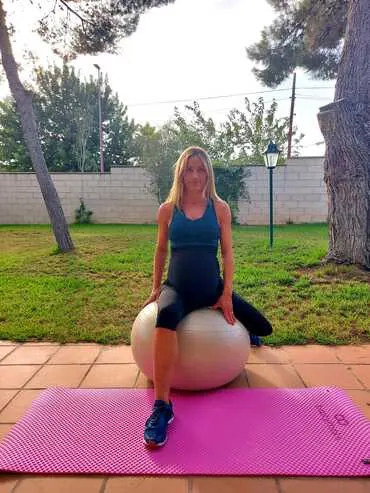
This last exercise, with the legs in an asymmetrical position, is especially recommended for women whose baby is lying diagonally (with the head not aligned in the middle of the pelvis).
-
Pelvic twists with the hips in external rotation.
This exercise relaxes the back, massages the sacral area and at the same time increases the diameter of the upper pelvis, as our hips stay in external rotation.
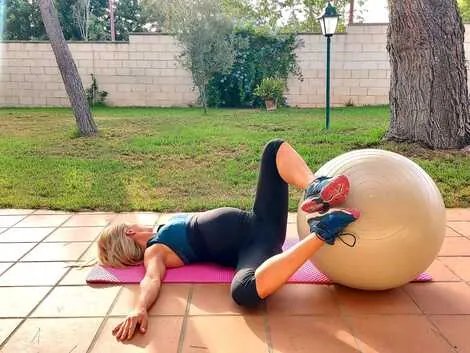
Starting position: lying on your back, rest your feet on the fitball and open your knees out to the sides as far as you can. Place your arms in a ‘T’.
Move the ball from side to side, turning your hips and head at the same time.
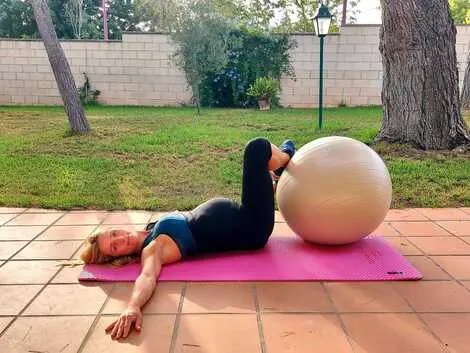
As you turn your hips to the left, turn your head to the right, and vice versa. Your shoulders stay on the floor the whole time.
Do about 20 repetitions.
-
Hip rotations in a semi-seated position.
Like the one we did on all fours, this exercise involves large external and internal hip rotation movements.
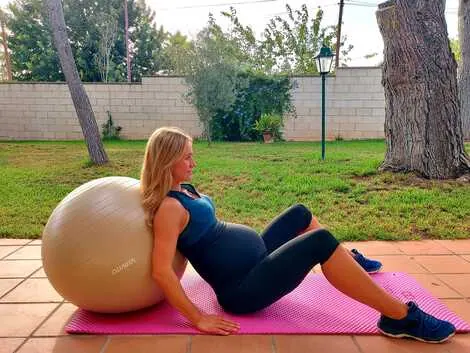
Starting position: sit on the mat and lean your back against the fitball, with your trunk reclined. Place your feet as wide apart as the mat.
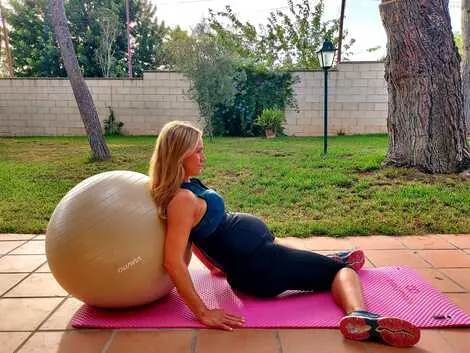
Move your knees to one side and then the other. They should touch the floor on each side. Your pelvis also turns from side to side. You can do about 10 movements on each side.
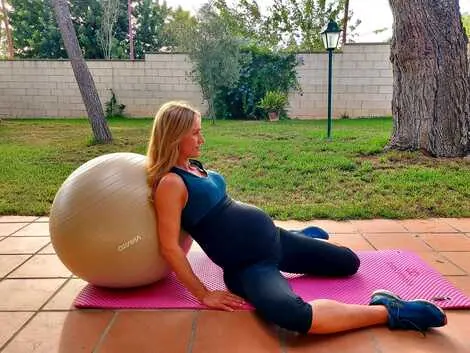
Remember that these exercises are designed to mobilize the pelvis and help the baby engage well before birth, but they’re just one more routine in the whole range of movements and workouts for pregnant women that you can and should do.


Prepare for your birth at our clinic in Valencia
We support you throughout your pregnancy with physiotherapy for pregnant women, adapted to each trimester and your situation. Can’t come to Valencia? We also see patients in an online consultation.