Which abdominal exercises you can do in pregnancy and which to avoid at all costs



Article content
Pregnancy brings many postural, physiological, hormonal and structural changes to women’s bodies. In the first trimester they’re not so visible or noticeable, but from the second trimester (week 12) we start to notice the abdomen and pelvis getting bigger.
These changes usually make women want to “stay in shape,” and among the most common exercises thought to help with this are abdominal exercises during pregnancy. But not all of them can be done while pregnant, so in this post we go over the most recommended abdominal exercises during pregnancy and those you shouldn’t do. Make no mistake, though: you can do abdominal exercises while pregnant.
Every body is different and every pregnancy is completely different. Some women don’t notice many changes in their body until the end of the second trimester, while others already have to adapt their daily activities or slow down at work to be more comfortable. For 9 months, the belly is the center of the changes we go through in pregnancy and brings different sensations. The abdominal cavity, surrounded by many layers of muscle, will change and adapt to make room for the growing baby and uterus.
This adaptation mainly consists of maintaining muscle tone throughout pregnancy, so the muscles can support the uterus, and stretching the abdominal muscles to allow natural expansion and create more space.
Is it normal for the abdominal muscles to stretch during pregnancy?
Yes, the superficial abdominal muscles, the rectus abdominis and the external obliques will stretch within their natural flexibility, creating a gap between the bands of the rectus muscle and leaving room for the baby to grow. It’s a completely natural and necessary process for a pregnant woman. Rectus diastasis is completely normal and shouldn’t be a cause for concern, as long as the gap doesn’t exceed 2.5 to 3 centimeters (about 1 to 1¼ inches) in width. Having abdominal muscles that are toned and at the same time elastic is the key to preventing postpartum problems.
When our abdominal muscles are too toned, that is, if before pregnancy we had defined abs with little elasticity, we may be at greater risk of severe diastasis during and after pregnancy. So overtraining or not improving the flexibility of the abdominal cavity would be a mistake.
Many sportswomen, lovers of traditional sit-ups, athletes and runners have very defined, hypertonic and inelastic superficial abdominal muscles. In these cases, such high tone doesn’t allow the muscles to stretch during pregnancy, and tears occur in the abdominal fascia. These are harder to treat and can cause pelvic floor problems.
Can I keep doing abdominal exercises during pregnancy?
Although abdominal exercises during pregnancy are accepted, some exercises are contraindicated. These are exercises that increase intra-abdominal pressure, making the belly button pop out and the rectus muscles tense. Examples of exercises to avoid are:
- Crunches (lifting the trunk).
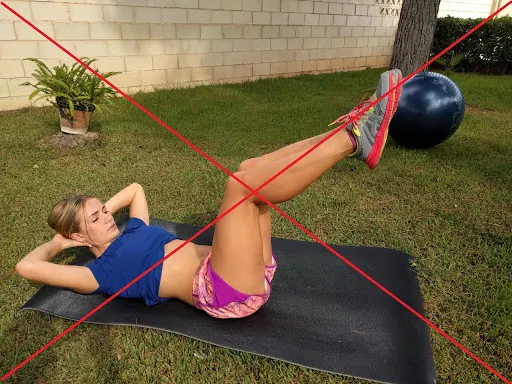
Photo 1: crunch abdominal exercise
- Front planks.
- Holding a “V” position (a common Pilates exercise).
- The “Roll Up” exercise, rolling up from lying down one vertebra at a time.
- Oblique exercises that lift the trunk.
All these examples are abdominal exercises that mainly activate the rectus muscles and increase intra-abdominal pressure. They widen the gap between the bands of the rectus muscle, make the pelvic organs descend further and weaken the pelvic floor.
Before I share the abdominal exercises I do recommend during pregnancy, remember that everything you do to protect your abdomen during pregnancy will affect your recovery and how you experience everyday things such as sex, the return of your period and using internal products… In my case, I’m an ambassador for Beppy Cup.

Which abdominal exercises are recommended during pregnancy?
When training with my pregnant patients, I always give the same guideline for working the abdominal muscles: do any abdominal exercise that lets you activate your pelvic floor for a birth without injuries at the same time.
Is it possible to do a crunch and contract your pelvic floor at the same time?
Definitely not. So during pregnancy, all exercises for the abdominal wall will focus on activating the internal muscles: the transverse abdominis and the internal obliques. These exercises are done with the spine lengthened (never bent), the pelvis in neutral and the right breathing. The deep abdominal wall and pelvic floor are activated on the out-breath, never the other way round. First we work in horizontal positions, without moving the arms or legs, and then we gradually add changes of position and body movement.
-
Step one: body awareness
To become aware of the deep abdominal muscles, we’ll need a small soft ball and a small towel.
Lie on your back with your legs bent. To place your pelvis in neutral, roll up the towel and put it under your lower back (allowing the lower spine to keep its natural curve). Then place the soft ball between your knees.
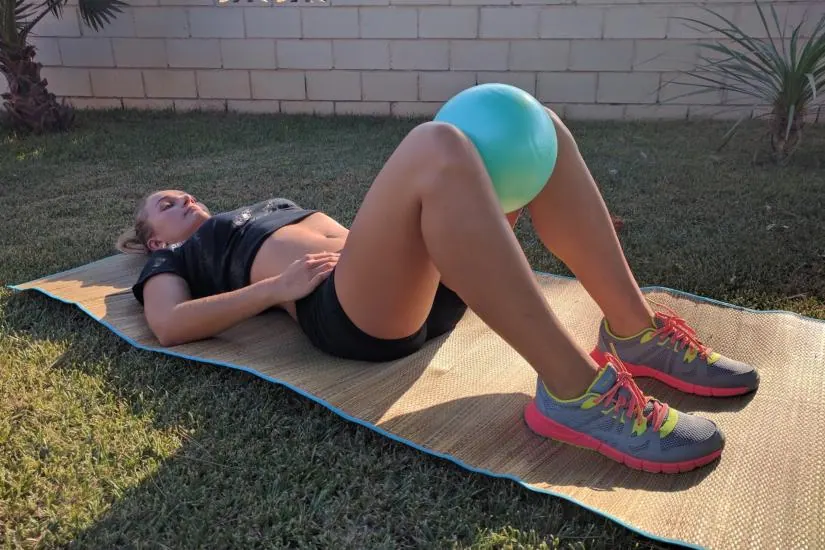
Photo 2: body awareness
Breathe in, opening your rib cage, and as you breathe out, activate your transverse abdominis, drawing your abs in (as if you wanted to hug your baby). As you activate the transverse abdominis, squeeze the ball and contract your pelvic floor. Hold the contraction for 10 seconds and relax as you breathe in. Repeat 10 to 20 times.
2. Step two: contracting the abdominal wall against resistance
To work the muscles against resistance, get down on all fours and activate your abdominal wall against gravity and the weight of the baby.
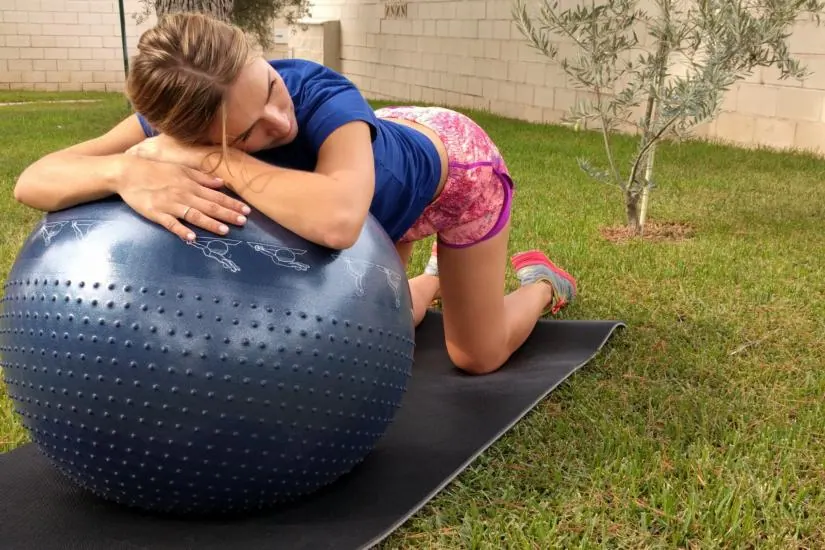
Photo 3: abdominal exercise against resistance
To do it, lean on a medium-sized Pilates ball with your knees hip-width apart. Your bump should be clear of the ball. Take a deep breath and, as you breathe out, activate your pelvic floor and transverse abdominis, with a feeling of “holding the baby, as if you wanted to draw it further in.” Hold the contraction for 10 seconds and relax as you breathe in. Repeat 10 to 20 times.
3. Step three: toning exercises with movement
The next step is to add movement to the muscle activation. One example is the side plank with your legs bent. It’s important to know how to activate the deep abdominal wall correctly before moving on to side planks.
If you’re still not sure you’re doing it right, see a physiotherapist specializing in prenatal exercise before starting this exercise so she can explain it.
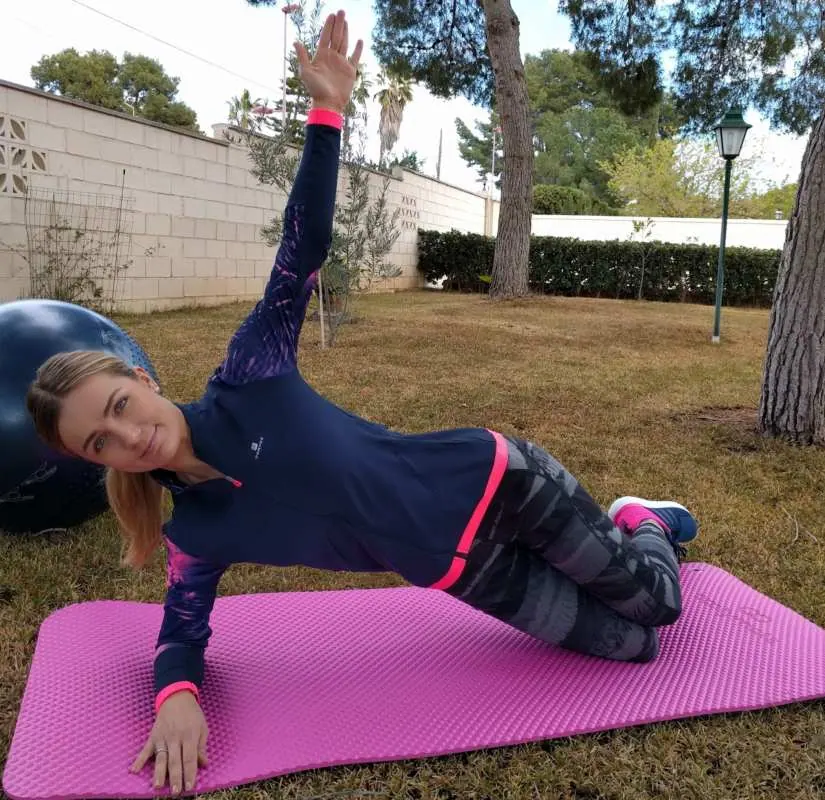
Photo 4: side plank with bent legs.
To do this abdominal exercise during pregnancy, lie on your side, bend your knees and lean on your forearm (your elbow should be under your shoulder). Take a deep breath and, as you breathe out, activate your transverse abdominis and pelvic floor and lift your trunk toward the ceiling. Breathe in as you lower back down to the mat.
As you lift your pelvis, the pelvic and abdominal wall activates. It’s important to check that your belly button stays “drawn in.” If it pops out, it’s a sign that this exercise is creating too much pressure in your lower belly. Repeat 10 to 15 times on each side.
4. Step four: increase flexibility
As I mentioned, if the abdominal muscles are too tense and not flexible enough, abnormal diastasis is likely, or even a tear in the membrane joining the rectus muscles. So we always add a stretching exercise before or after this routine.
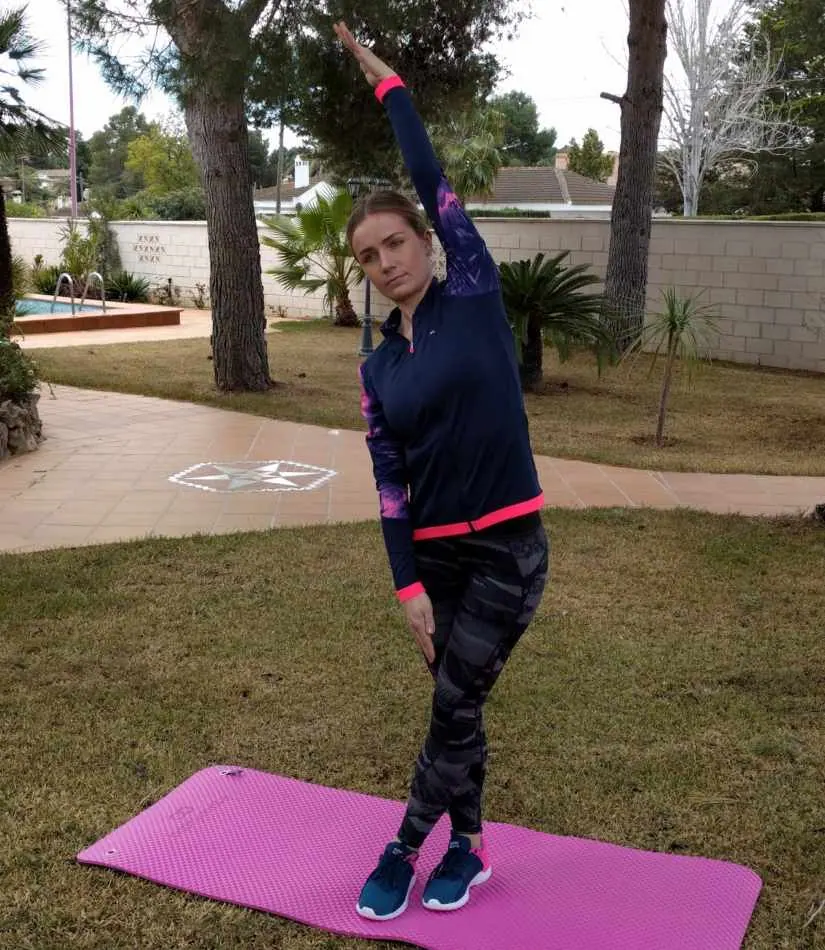
Photo 5: abdominal stretch.
Standing, cross your legs, placing your left foot in front of your right foot. Raise your left arm and lean your trunk to the opposite side, forming a “C.” You should feel a gentle stretch in your groin, the side of your abdomen, your side and your armpit. Then switch sides. Repeat 10–15 times on each side.
What guidelines should I follow to keep my abdomen in shape during pregnancy?
As with any other exercise, good technique is essential to maintain good tone and good elasticity. So if you’re not sure how to contract your pelvic floor and abdominal wall correctly, it’s a good idea to attend prenatal classes and exercise under the supervision of a physiotherapist specializing in obstetrics.
For exercise to be effective, we should follow these guidelines:
- Abdominal exercises during pregnancy should be done before eating (never on a full stomach).
- They should be done at least twice a week.
- Wear comfortable clothing, such as stretchy pants that let you feel the muscle contraction.
- Start once you’ve completed the first trimester and continue until the end of pregnancy.
- Before starting, tell your gynecologist about the activity you’re going to begin.
- Use small and large balls and inflatable cushions to activate the muscles better.
- Any discomfort in the belly, prolonged contraction, bleeding, dizziness or difficulty breathing should be a sign that something is wrong, and you should see a doctor.
- Exercise will always be more effective under the supervision of a professional specializing in prenatal Pilates.
Now you know that pregnant women can do abdominal exercises, and everything to bear in mind so they’re safe and beneficial.
If you’d like a professional to advise you on the steps to take in preparing for birth, at SueloPélvico we’ll offer you the best personalized care. Book your appointment now!


Prepare for your birth at our clinic in Valencia
We support you throughout your pregnancy with physiotherapy for pregnant women, adapted to each trimester and your situation. Can’t come to Valencia? We also see patients in an online consultation.