
What vaginismus is: its symptoms and how it’s treated with physiotherapy




Article content
Explaining the different pelvic floor dysfunctions, their symptoms and how to treat them is a mission I’ve set myself to raise women’s awareness of how important it is to look after their pelvic muscles.
Only in this way can we prevent injuries that can lead to serious conditions such as urinary and/or fecal incontinence, genital prolapse, dyspareunia, or the condition we’ll cover in this post: vaginismus.
We’ll talk about what vaginismus is, its symptoms, what causes it and how it’s treated with physiotherapy.

What is vaginismus?
To answer the question of what vaginismus is, we need to know that it’s a dysfunction of the genital system. It causes persistent difficulty in allowing a penis, a vaginal device (for example, the speculum gynecologists use) or a finger to be inserted.
Unlike dyspareunia, vaginismus doesn’t in itself mean pain. Rather, it’s hypertonia of the superficial muscles and, in some cases, also of the deep muscles of the pelvic floor. This increased muscle tone closes the vaginal opening and, as a result, causes pain at any attempt at penetration.
Types of vaginismus
There are two types of vaginismus:
- Primary vaginismus: related to a psychological problem or to the kind of sex education the woman received from those around her, which disrupted her sexual function. With primary vaginismus, the woman has never been able to have sex without pain.
- Secondary vaginismus: occurs when the woman has had a normal, pain-free sex life but a traumatic event caused a spasm of the pelvic floor muscles. This could be a rape, a complicated birth, surgery or hormonal changes.
Symptoms of vaginismus
To understand what vaginismus is, it’s also important to know its symptoms. They can be mild (a burning sensation) or very intense. The latter are the ones that close the vaginal opening completely. The pain usually occurs during sex, but in some cases it can last for several days after penetration.
The most common symptoms of vaginismus are:
- Pain, burning and itching during sex.
- Pain that makes penetration impossible (very superficial pain at the entrance to the vagina).
- Muscle tension before penetration begins.
- Difficulty, pain or discomfort when inserting a tampon.
- Painful gynecological examinations, such as a transvaginal ultrasound, palpation of the vaginal walls or inserting a speculum to take a Pap smear.
- A final possible symptom of vaginismus is anorgasmia, the absence or lack of orgasm during sex.
Causes of vaginismus
The next aspect of vaginismus we’ll look at is its causes. The truth is that diagnosing vaginismus and establishing its cause is very difficult, as physical and psychological causes usually combine.
Often, after successful treatment for vaginismus, if the symptoms return the patient has pain during sex again, because her body produces an involuntary muscle contraction whenever it anticipates pain. The body’s unconscious reaction is to contract the muscles.
Below is a list of possible psychological and physical causes, although in reality the cause is almost always a combination of both.
Psychological causes of vaginismus
- Fear of pain, of getting pregnant, of vaginal birth or of any genital procedure.
- Negative feelings about sex.
- Anxiety or chronic stress.
- Relationship problems, such as mistrust, lack of emotional support or abuse.
- Sexual abuse experienced by the patient in the past.
- Lack of sex education at home, the influence of religious upbringing or the demonization of sex.
- Negative feelings about sex as a result of insecurities, such as body changes after pregnancy, birth or menopause.
Physical causes of vaginismus
- Internal and/or external perineal scars (episiotomies, tears or genital surgery).
- Painful, prolonged and instrumental births.
- Miscarriages or abortions.
- Cesareans.
- Damage to the vaginal tissue.
- Hormonal changes during menopause (poor vaginal lubrication).
- Radiotherapy or chemotherapy.
- Use of certain medicines.
How to treat vaginismus with physiotherapy
Finally, to give a broader view of vaginismus, let’s look at its treatment.
Joint work between a physiotherapist specializing in gynecology and psychology professionals is essential in diagnosing and treating vaginismus. Because almost every case involves a combination of physical and psychological causes, both specialties are usually involved.
Treatment for vaginismus requires, first of all, a lot of time and patience on the part of the patient. Second, the understanding and professionalism of the specialists treating her will be essential.
The overall goal of physiotherapy for vaginismus is to train the pelvic floor muscles to respond correctly and in a controlled way to sexual stimulation or any kind of vaginal penetration.
Treatment for vaginismus combines education, instrumental techniques and exercises.
Education
In the first physiotherapy sessions, the patient is taught the anatomy of the pelvic floor muscles and how they work.
This means showing her where the muscles attach, where they are and what they do. To make it easier to understand, we use images of the female pelvis, videos showing how the pelvic floor works, diagrams, pelvic models showing all the muscles, and so on.
Then a simple exercise is done to help locate the pelvic floor. The patient is asked, in a comfortable position (for example, lying down with her legs bent), to feel the bones of her pelvis: the iliac crests, pubis, sacrum and sit bones.
This way she can locate where the muscles attach, which helps her understand her anatomy and how it works.

Instrumental techniques
To treat this condition, dilators for vaginismus are used, which can help stretch the vaginal tissues.
Dilators are elongated plastic or silicone devices in various sizes. When using them to treat vaginismus, you start with very slim dilators and gradually increase the size.
Their main functions are stretching the pelvic floor tissues and reducing muscle spasms when there is a feeling of having something inside the vagina. It’s important to do the treatment under the supervision of a specialist physiotherapist, as the technique may differ for each case.
To make the device easier to insert, a lubricant is used and, once it’s in place, various techniques are applied: gently increasing the depth of insertion, rotating the dilator, applying pressure or doing a circular massage to find the points of greatest tension.
This treatment is usually done 2 to 3 times a week, with each session lasting 10 to 15 minutes.
Exercises
Kegel exercises
Although Kegel exercises for women involve a muscle contraction that could in theory increase the symptoms of the dysfunction, they play a very important role in treating vaginismus: teaching the muscles how to relax.
Alternating contractions and relaxations teach the patient and her muscles to tell the difference between contracting and relaxing.
In clinic we often see patients who know perfectly well how to activate their pelvic floor but can’t relax it consciously. That’s why learning to relax this area involves practicing these exercises together with deep breathing.
To do these exercises, get into a comfortable position, for example sitting on a chair (as in the picture). Then place your pelvis in a neutral position, so you can feel your sit bones (the bones in your bottom) resting on the chair. Next, lengthen your whole spine upward and rest your hands on your thighs to relax your shoulders.
Take a deep breath (without activating your pelvic floor) and, as you breathe out, contract it. To do this, close your sphincters and try to lift them upward.
The contraction should last 5 seconds and the relaxation 10 seconds, because the muscles need twice as long to relax completely as to contract. Repeat 20 times.

Stretches
It has been observed that many women with pelvic floor hypertonia also have lower back pain and increased muscle tone in the glutes and back.
If this happens, we should add stretches for these muscles to our daily routine to support vaginismus treatment, such as yoga, Pilates or global stretching.
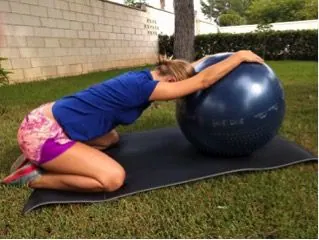
To do this, as shown in the next picture, kneel down (with your knees apart and your ankles together), stretch your back and arms forward and rest your hands on a fitball.
Try to keep your buttocks resting on your heels and, from there, lengthen your spine and arms forward as much as you can. It’s important to breathe deeply and stay in this position for about 5 minutes.
Perineal massage
Perineal massage is done in the final stage of recovery, when there is no pain or discomfort.
The first session is done in clinic under the supervision of a physiotherapist specializing in gynecology, so the patient can do it correctly at home, even with her partner’s help.
Bear in mind that perineal massage is effective when vaginismus is caused by scars after births or genital surgery, pelvic adhesions or after radiotherapy. For scars, using silicone scar sheets could reduce the chances of vaginismus developing.
This type of treatment for vaginismus consists of a gentle massage of the outside of the vagina (with a lubricant) and then inside it. It should be done at least three days a week.
I hope this article on what vaginismus is has not only helped women who have this condition but also, as we said at the start, raised awareness of how important it is to exercise your pelvic floor.


We can help with vaginismus in Valencia
We take it step by step, at your own pace, with physiotherapy for vaginismus. Can’t come to Valencia? We also see patients in an online consultation.