An exercise routine for menopause and pelvic floor changes



Article content
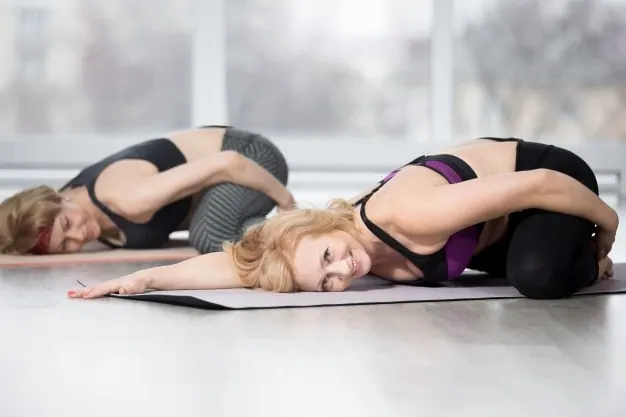
Menopause is a stage in every woman’s life that marks the end of the fertile years and opens a new chapter, which is different and unique for each of us. But one thing that does happen to all of us is that menopause brings changes to our pelvic floor.
That’s why, in today’s post, I’m sharing an exercise routine for menopause that you can do at home to help prevent the pelvic floor problems we may experience. I also want you to understand the benefits of exercise during menopause.
What happens inside our bodies during menopause?
During menopause, estrogen levels fall, reducing muscle tone, especially in the abdominal and pelvic region. This can encourage pelvic floor problems such as urinary incontinence, fecal incontinence or uterine prolapse, which are the most common pelvic injuries in menopause.
The ovaries, which produce estrogen during a woman’s fertile years, protect the bones. So the drop in these hormones during menopause explains the loss of bone mass and the increase in fractures. Weakness of the pelvic and abdominal muscles increases the risk of these fractures even further, especially in the lower spine, hips, sacrum or pubis.
With all this in mind, it’s precisely during this period, more than ever, that we women should be aware of the benefits of exercise during menopause and the importance of following an exercise routine. Above all, we need to exercise the pelvic floor, the deep abdominal muscles and all the soft tissues involved in maintaining good lumbopelvic stability. Along with various exercises, Kegel balls can be used to complement this pelvic floor strengthening.
The most common pelvic floor problems in menopause
We know that not all women have the same hormone levels, and that the risk of a urogynecological problem isn’t the same for everyone. To help you understand which conditions are most common, I’ll focus on the real cases I see among my patients going through menopause.
Stress urinary incontinence
Urinary incontinence is urine leakage that happens when you cough, sneeze, laugh, lift something heavy, jump… in other words, when you exert yourself. Women with this type of incontinence have weakness of the urethral sphincters and of all the muscles around the vagina.
Often they are patients who have had more than two vaginal births with perineal tears or episiotomies, and little or no postpartum recovery. To prevent urinary incontinence, it’s important to exercise during menopause.
Bladder or uterine prolapse
Prolapse, as I explained in this article, means the descent of an organ. In these two specific types, the bladder and uterus descend through the vagina.
When the abdominal muscles, pelvic floor and the whole ligament system of the pelvis are weakened, their supporting function becomes almost impossible. The weight of the bladder and uterus on the pelvic floor makes it drop and overstretch, losing its ability to bear weight.
In these cases, patients notice a bulge, as if there were a weight in the vagina. They also often feel heaviness in the vaginal and urethral area when they get up or lift something. To avoid these symptoms, it’s important to exercise during menopause.
Constipation
Reduced tone in the abdominal and pelvic muscles slows down bowel transit. When a patient has fewer than three bowel movements a week, we can say she has constipation. If this lasts for more than a month, we can call it chronic constipation.
Lower back pain
Because of bone loss in the lower spine and pelvis, together with the weakening of the deep abdominal muscles and the pelvic floor (also known as the core), women over 60 are at greater risk of chronic pain in the lumbopelvic region.
The discomfort is mainly felt in the lower back and often travels down one leg (the buttock or the back of the thigh). If we add any spinal problem such as a curvature of the spine, a bulging disc or a herniated disc, it’s essential to have the right treatment and therapeutic exercise during menopause.
How can we prevent pelvic floor problems in menopause?
For prevention, the most important thing is to see a gynecologist regularly, who will decide whether hormone replacement therapy is needed and check the condition of our pelvic organs.
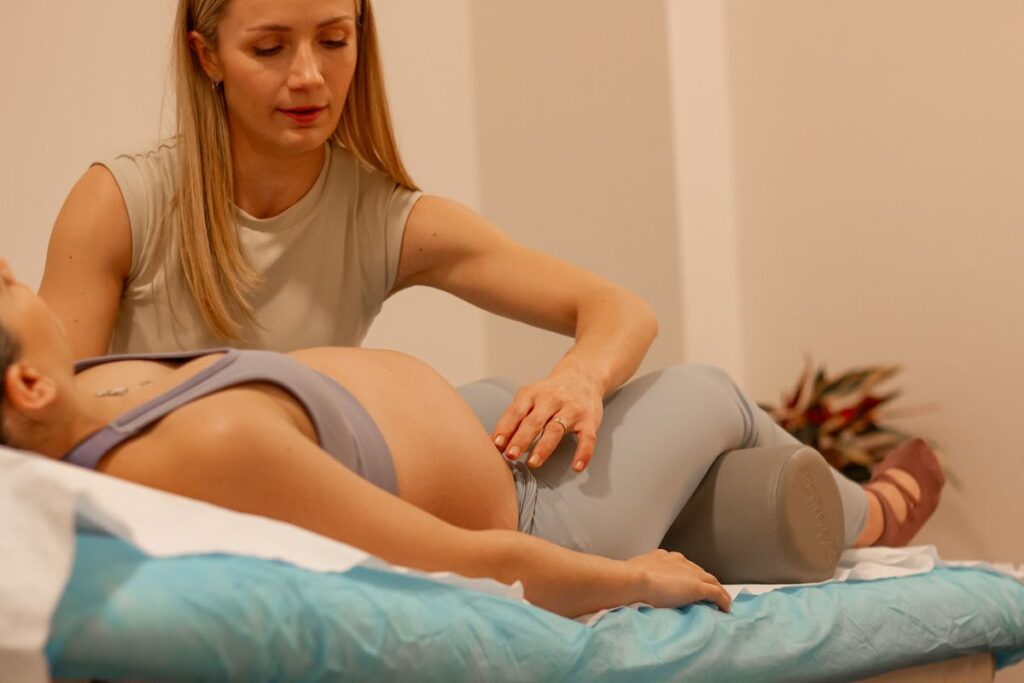
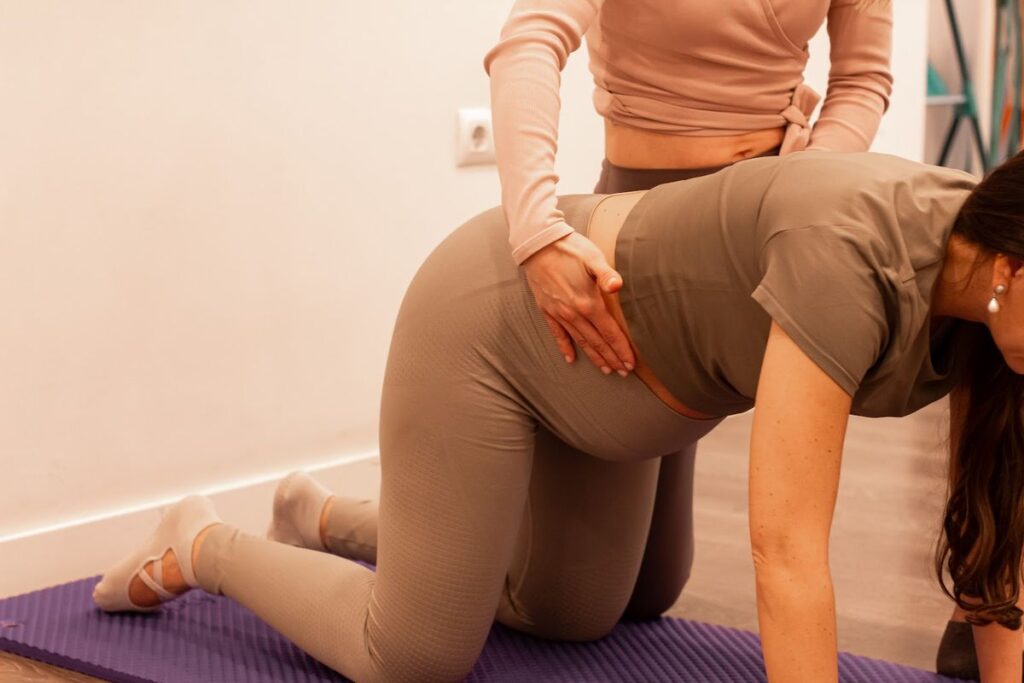
Gynecologists usually recommend seeing a physiotherapist specializing in urogynecology, who can assess the condition of the pelvic floor and abdominal muscles and, if necessary, decide on the type of rehabilitation. Sometimes, though, all that’s needed is guidance on an exercise routine for menopause that we can do at home.
To prevent and also reduce the symptoms of the problems I’ve mentioned in this article, the most important thing is to do the right exercise regularly during menopause.
What is recommended when exercising during menopause?
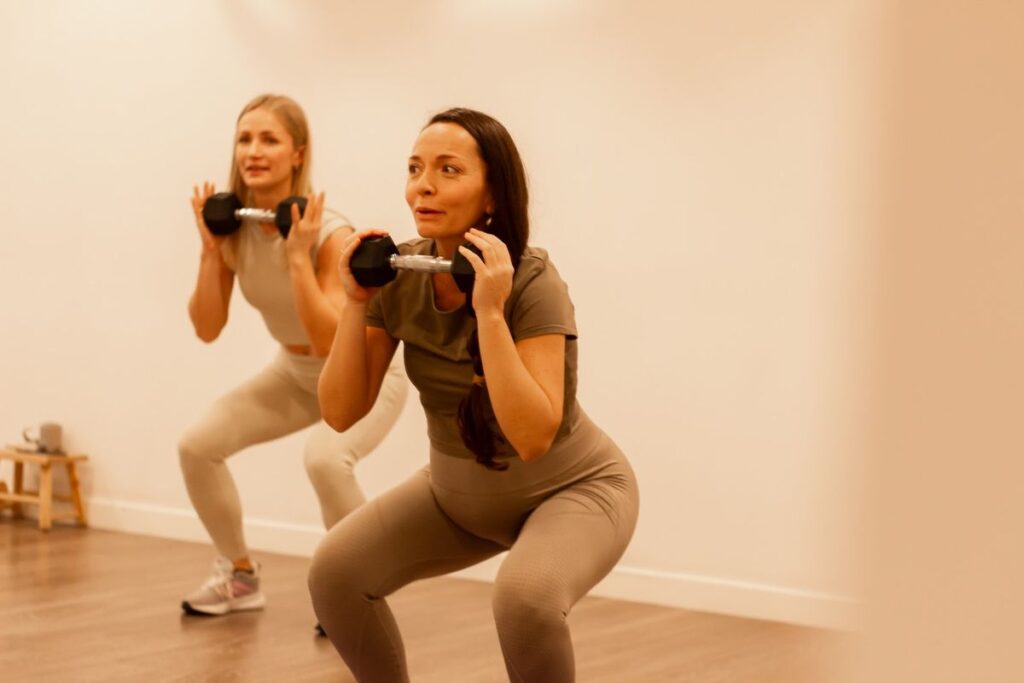
I recommend that the first sessions are done under professional supervision; after that, you can continue at home. It’s also highly recommended to attend Pilates classes for menopause, where exercises are done in small groups supervised by a physiotherapist specializing in gynecology.
But, as I’ve said, the most important thing of all is to be aware of the benefits of exercise during menopause.
Exercise routine for menopause
Below is an exercise routine for menopause focused on toning the pelvic floor, the transverse abdominis and the deep back muscles.
To do the activities correctly and avoid unnecessary pain, a pelvic support belt can help.
How often should you do this exercise routine for menopause?
We should do this exercise routine at least twice a week, with the aim of preventing urinary incontinence and descent of the internal organs, easing lower back pain and improving bowel transit. The exercises are:
-
Body awareness
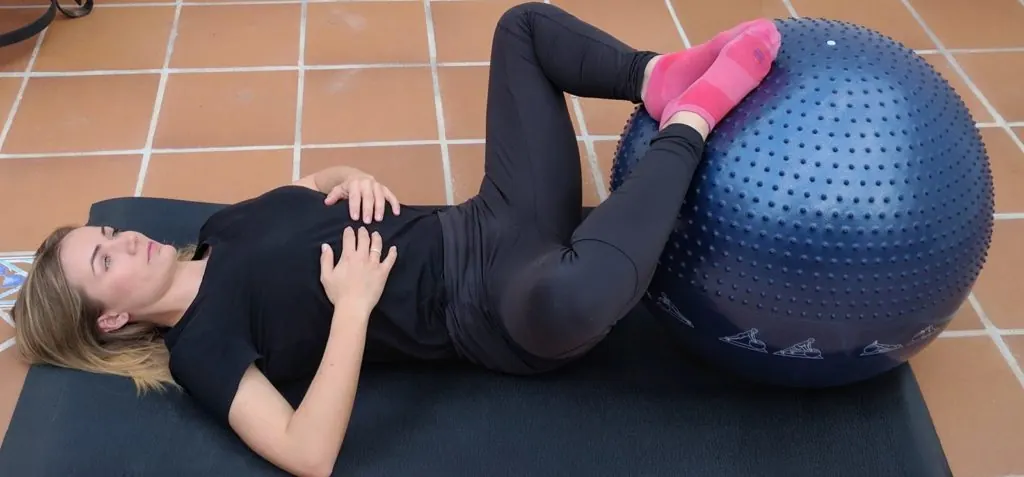
Lying on your back, rest your feet on the fitball with your legs in a frog position. Place your hands on your lower ribs to feel your rib cage move.
Once you’re in position, breathe in deeply, opening your ribs (instead of inflating your tummy, inflate your rib cage) and, as you breathe out, contract your pelvic floor (closing the sphincters, as if you wanted to stop the flow of urine).
In this exercise, the contractions should be slow, held for 10 seconds, and the relaxation should be even longer, about 20 seconds. Repeat 10 times.
-
Shoulder bridge on the fitball
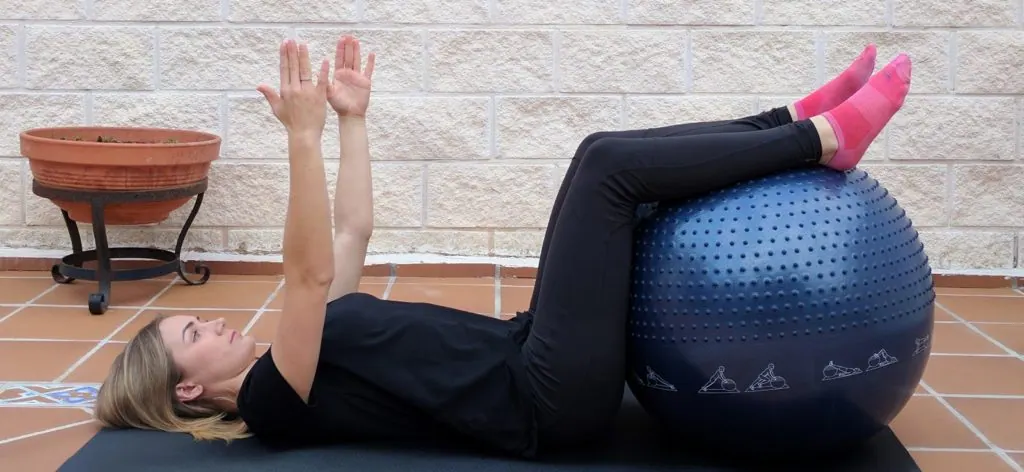
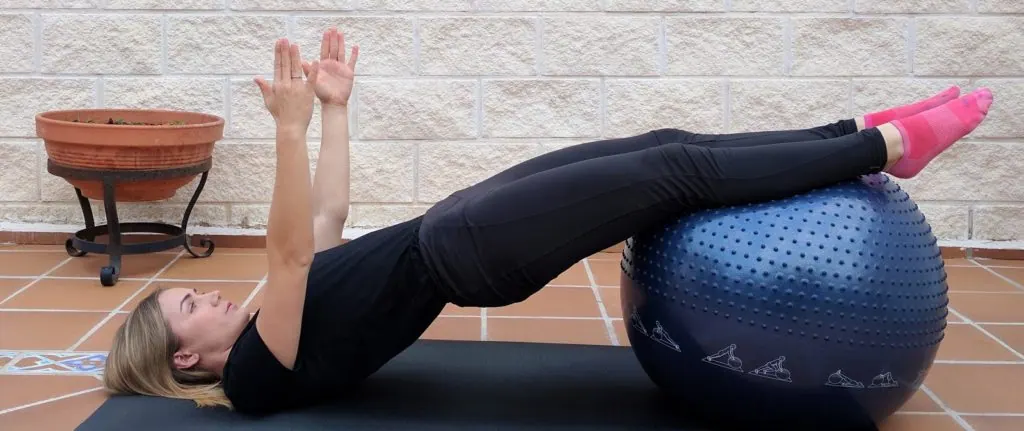
Lying on your back with your legs bent and resting on the ball, stretch your arms toward the ceiling.
In this position, take a deep breath and, as you breathe out, activate your deep abdominal muscles (drawing your belly button in) and lift your pelvis and spine. Roll up one vertebra at a time, slowly, making sure you keep your balance. Breathe in with your trunk raised and, as you breathe out, roll down the same way (one vertebra at a time). Repeat 10 times.
In this exercise we activate the deep trunk muscles to tone them and improve lumbopelvic stability. The first picture shows the starting position and the second the end position.
-
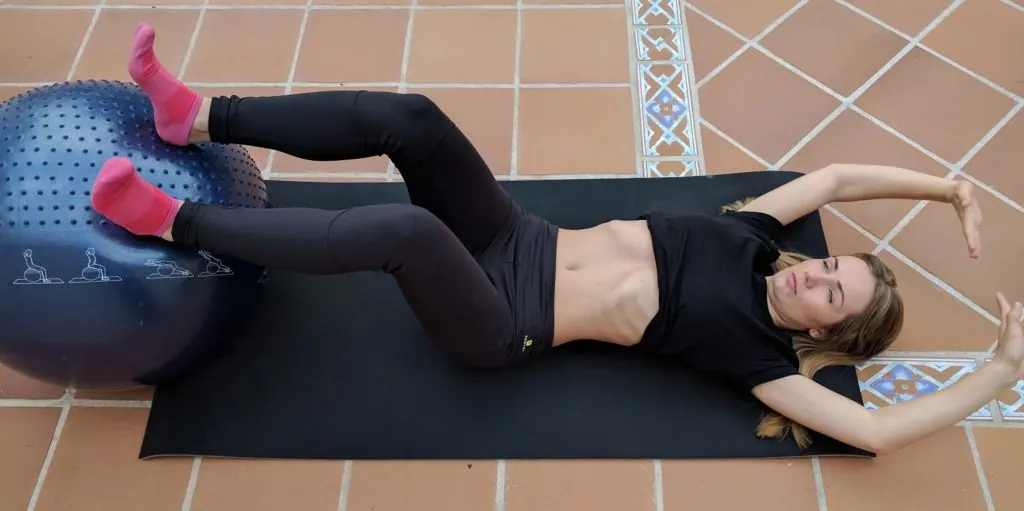
Hypopressive exercise
Lying on your back with your legs bent, rest your heels on the ball. Then take your arms back into the hypopressive position: elbows slightly bent, wrists flexed and hands turned inward.
Take 3 normal breaths and, on the last exhalation, breathe all the air out and then, while holding your breath, expand your rib cage (open your ribs as if you wanted to take a breath). Hold your breath for 10 seconds. Repeat the whole sequence 10 times.
-
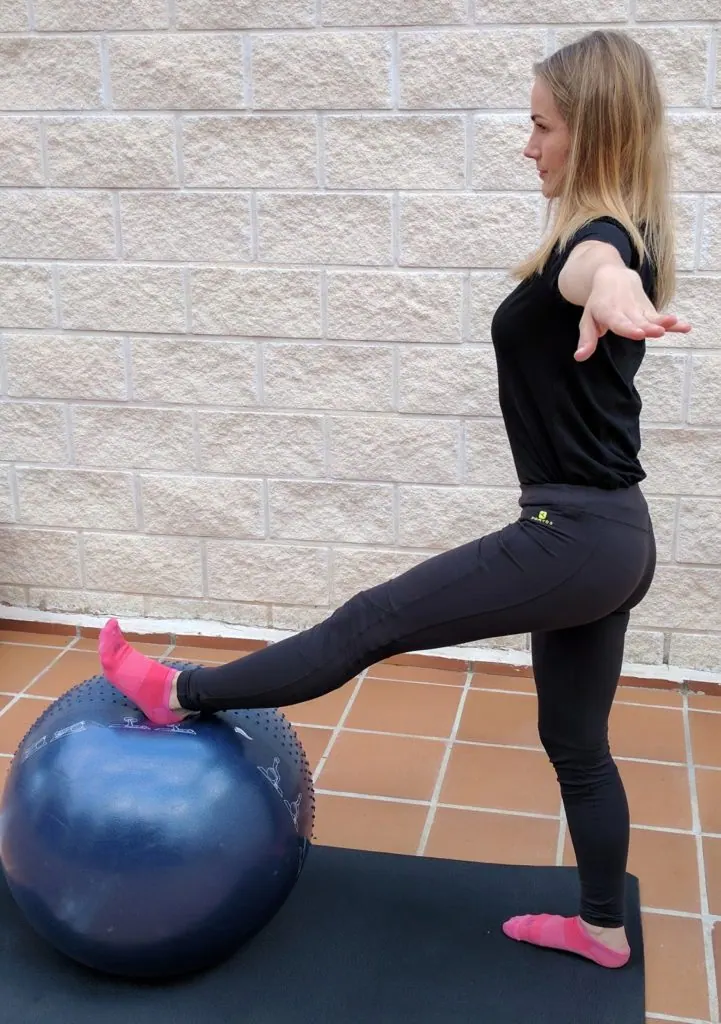
Balance
Standing, lengthen your spine toward the ceiling, open your arms out to the sides and rest one foot on the ball. Start with one leg on the ball, bent at 90 degrees.
Then take a deep breath and, as you breathe out, straighten your leg in front of you (rolling the ball along the floor). Breathe in as you bend it again.
The aim of this exercise is to straighten and bend your leg without losing your balance or the length in your spine. You’ll feel your pelvic floor and deep abdominal muscles activate. Do 10 repetitions on each leg.
-
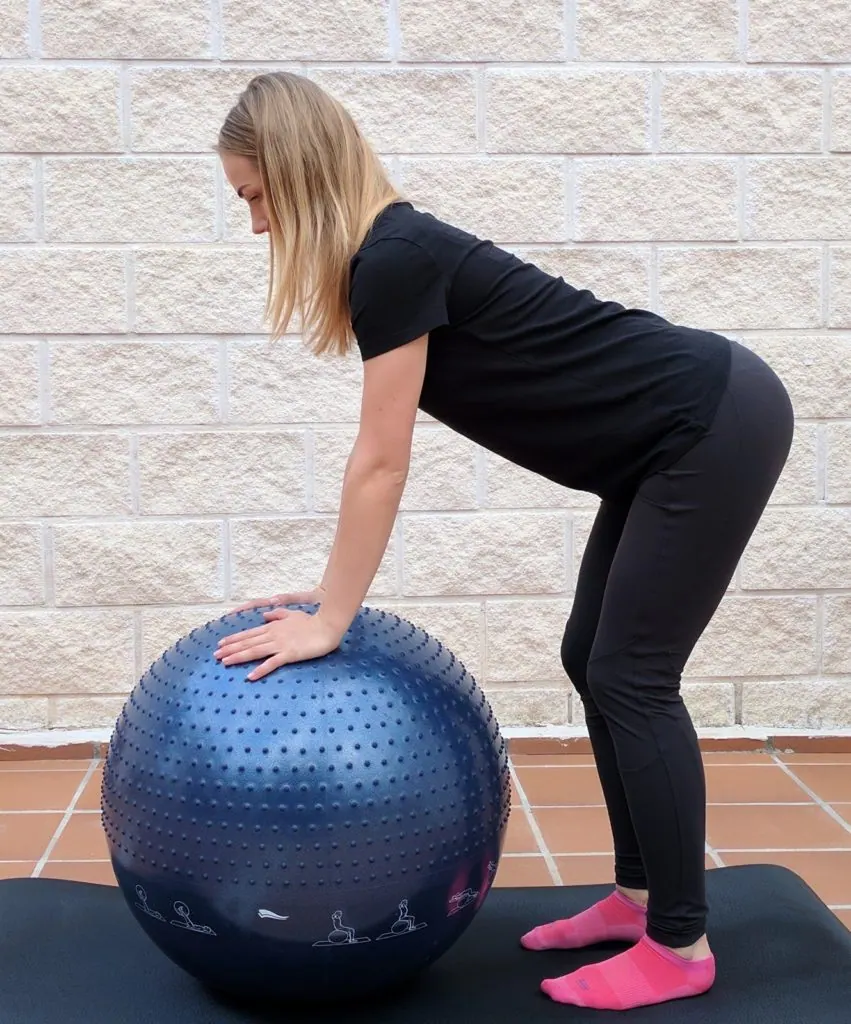
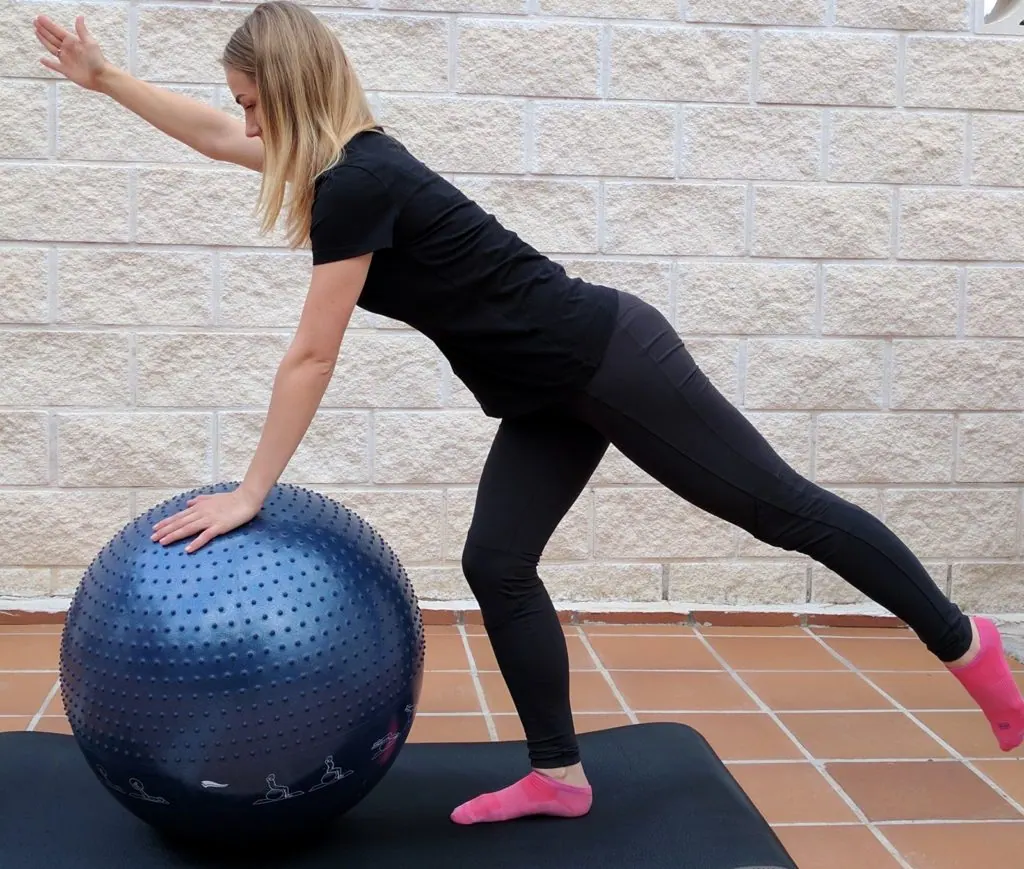
Core
The starting position is standing with your knees slightly bent (so as not to load your lower back) and your hands resting on the ball (with your wrists just under your shoulders).
Breathe in deeply and, as you breathe out, stretch your left leg back and your right arm forward. Hold the position for 5–10 seconds, feeling your abdominal and back muscles activate. Repeat 10 times on each side. The first picture shows the starting position and the second the end position.
This exercise routine for menopause will help you ease any pelvic floor problems or injuries you may have. These are muscles we should definitely look after.


Look after your pelvic floor during menopause, in Valencia
We explain what’s happening in your body and find what suits you with physiotherapy for menopause. Can’t come to Valencia? We also see patients in an online consultation.