
Exercise in pregnancy: 5 Pilates exercises to do at home



Article content
In today’s post, we explain the three options pregnant women have for exercising: doing it yourself at home, taking individual classes or going to group classes. Today we’ll explain 5 exercises so you know how to do Pilates at home.
We think it’s important to cover this topic, because exercise matters not just during pregnancy but always, whatever your age. But during pregnancy in particular, it’s highly recommended to exercise and prepare your body for the moment of birth.
First, though, you need to talk to a specialist, know what your goals are and at what point in pregnancy you can start exercising.
Before you start exercising, talk to a specialist
Before we get into how to do Pilates at home, it’s important to mention how essential it is to have an initial assessment and record of the condition of your pelvic floor. Only then can the right exercise program be chosen, and the results can be compared with the postpartum assessment.
This makes it possible to determine, if there is a dysfunction, whether it was caused by the birth or was already present during pregnancy.
The initial assessment also checks the mobility of the pelvic joints and spine and the tone of the abdominal muscles, and identifies any diastasis, muscle knots, painful spots, asymmetries, etc.
Examining the patient beforehand is essential to know whether the woman needs specific physiotherapy treatment, so she can be as well prepared as possible for a vaginal birth or a cesarean.
The goals of physical birth preparation
The goals and reasons why it’s so important to have a Pilates routine to do at home, or to exercise in general, are:
- Breaking the fear-tension-pain cycle.
- Reducing common aches and pains (lower back, mid-back, neck and pubic pain, sciatica).
- Maintaining or improving pelvic floor tone.
- Toning the deep abdominal muscles (important during the pushing stage).
- Stabilizing the trunk (postural re-education).
- Improving balance.
- Boosting circulation.
- Making the pelvic joints more flexible.
I’m pregnant: when can I start exercising?
The effects of pregnancy and birth are different for every woman. Pregnant women go through different postural, hormonal and emotional changes during pregnancy, and every birth is unique. So if what happens “during” and “after” giving birth depends on each woman, it makes sense that birth preparation should also be individualized and adapted to each case.
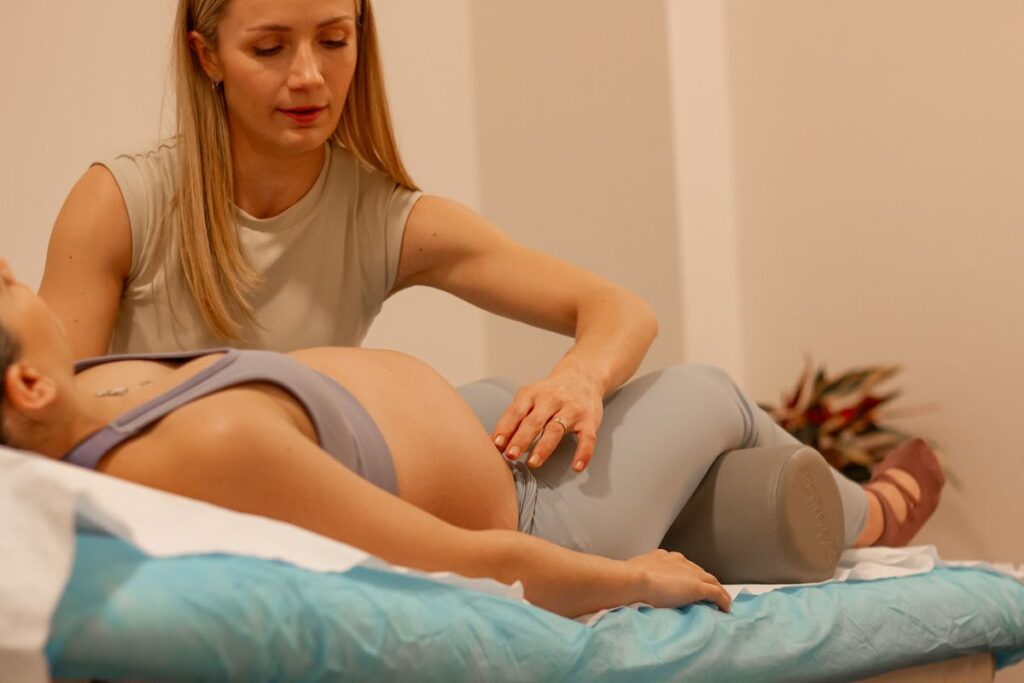
Exercise during pregnancy can be done individually (private classes) or in a group (group classes). In most cases, gynecologists and midwives recommend that patients go to Pilates classes for pregnant women and/or prenatal yoga.
Either way, you should talk to a specialist first and bear in mind that the first trimester starts in week 1 of pregnancy and ends at the end of week 12. The second trimester runs from week 13 to the end of week 26, and the third trimester from week 27 to the end of pregnancy.
Whatever stage of pregnancy you’re at, the specialist will most likely recommend using a pelvic support belt to exercise. You have two main options:
- Confort pelvic support belts. For women above EU size 40 (US size 10).
- Tonic pelvic support belts. For women below EU size 40 (US size 10).
Exercising in group classes
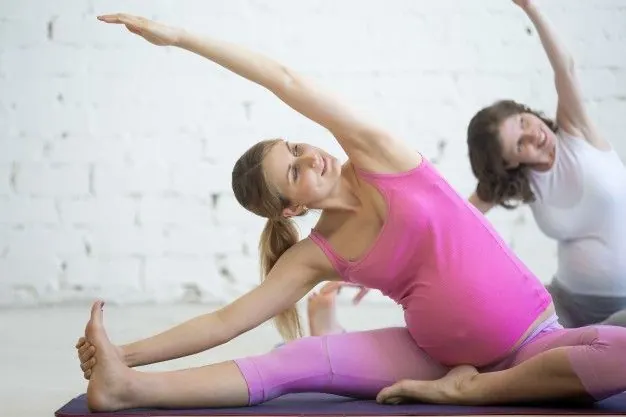
In group classes, theory is combined with practice, and the session is adapted to the needs of the group of pregnant women.
To keep good track of everyone in the group, it’s recommended to go to classes with a limit of 5 or 6 people. It’s also important that the group includes only pregnant women with no risk of premature birth and no health problems, in other words, healthy women.
It’s recommended to start group classes from the second trimester, as the pregnant woman no longer has such a high risk of miscarriage (as she does in the first trimester). So it’s safer to start physical activity at this point.
This is usually when the belly starts to grow, the joints become more flexible, and the woman is more aware of her condition and starts to care about her fitness.
Exercising in individual classes
These classes are offered when the woman has lower back pain, pelvic pain or sciatica in pregnancy. That’s why individual classes can start from week 10 of pregnancy: they’re supervised by a specialist, such as a physiotherapist, and focused on the pregnant woman’s needs and limitations.
You start with gentle exercises focused on the lower back and pelvis and gradually add more full-body exercises.
Recommended aerobic activities for pregnant women
It’s also recommended to do aerobic exercise once or twice a week to keep the cardiovascular system in good shape and improve circulation in the lower body.
The recommended aerobic activities for pregnant women are:
- Swimming.
- Water-based group classes for pregnant women.
- Brisk walking.
- The elliptical or a stationary bike.
This kind of aerobic exercise should be combined with toning exercises (such as Pilates) and done 2 or 3 times a week.
5 exercises to show you how to do Pilates at home
These 5 Pilates exercises to do at home (from the second trimester of pregnancy), done 3–4 times a week, will help you prevent back pain and improve your fitness before giving birth.
-
-
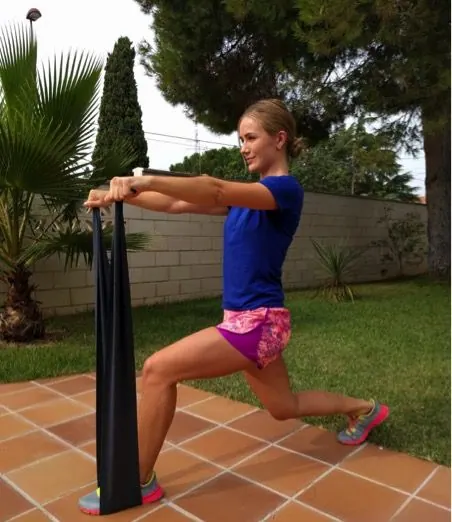
At-home Pilates exercise with a resistance band
Position
For this at-home Pilates exercise, stand with your left leg forward (about a meter, or 3 feet, from the other) and step on the middle of the band. Then hold the ends of the band with both hands and stretch your arms alongside your trunk.
Movement
- Take a deep breath and, as you breathe out, raise your arms to shoulder height (without bending your elbows or wrists).
- At the same time, bend both legs (bending both knees to 90 degrees).
- Hold this position for about 3–4 seconds and, as you breathe in, return to the starting position.
- Repeat 10 times and then switch legs.
- Repeat another 10 times.
Important
- For this at-home Pilates exercise, keep your back straight (spine lengthened) throughout the movement.
- Activate your core (the deep abdominal muscles) as you lower your trunk.
-
At-home Pilates exercise for beginners: mermaid pose
Position
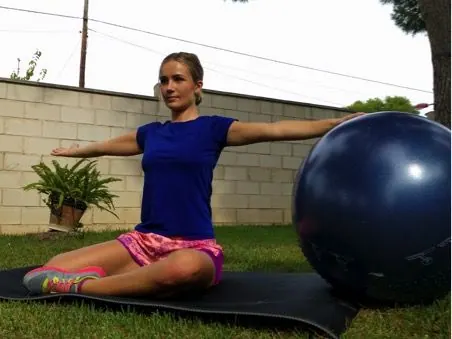
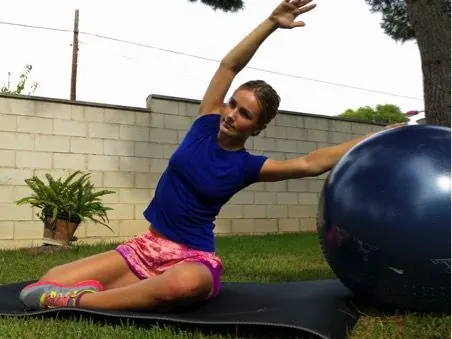
For this at-home Pilates exercise for beginners, sit in the mermaid position: with both knees bent, place your left leg in front and take your right leg back (as in the photo).
Keep both sit bones (the bones of your buttocks) in contact with the floor and rest your left arm on the fitball. Finally, open your other arm out to the side (palm facing the ceiling).
Movement
- Take a deep breath (lengthening your spine) and, as you breathe out, lean your trunk to the left, keeping both arms straight.
- Return to the starting position as you breathe in.
- Repeat 10 times and then switch sides.
- The first photo shows the starting position and the second the final position.
Important
- Keep both elbows straight during the movement and both buttocks in contact with the mat.
- The aim is to stretch both sides of the trunk and the lower back muscles with the pelvis stable on the floor.
-
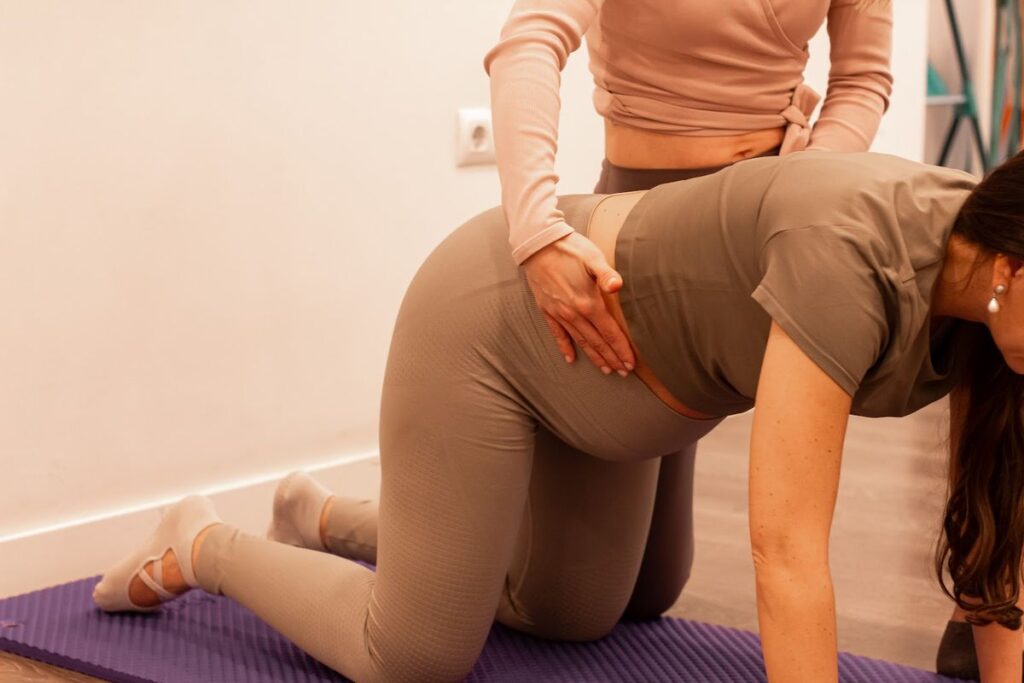
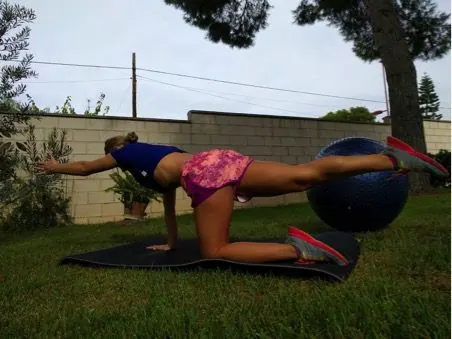
At-home Pilates for pregnant women: on all fours
Position
For this at-home Pilates exercise for pregnant women, get on all fours. Place your knees under your hips and your wrists under your shoulders.
Next, lengthen your spine (keeping its natural curves), align your head with the rest of your spine and then tuck your chin in.
Movement
- Take a deep breath and, as you breathe out, activate your transverse abdominis (draw your belly button in and close your rib cage).
- Stretch one leg back and the opposite arm forward.
- Hold this position for 5 seconds and return to the starting position.
- Repeat 10 times on one side and then switch sides.
Important
When you stretch out your limbs, don’t arch your lower back further. If you feel your lower back arching too much or your pelvis turning to one side, stretch your leg without lifting it (stretch it back, keeping your toes on the floor).
-
At-home Pilates exercise for beginners with a fitball
Position
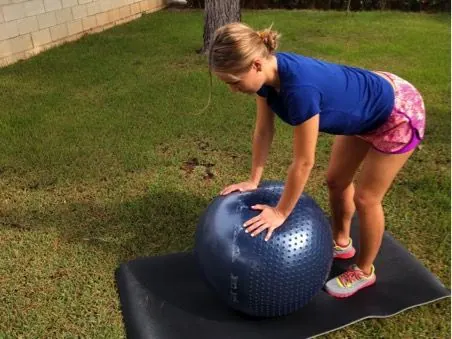
For this at-home Pilates exercise for beginners with the large ball, stand with your feet hip-width apart, bend your knees slightly so you don’t lock your lower back, and rest your palms on a large ball (fitball). Keep your spine lengthened and your shoulders away from your head.
Movement
- For this at-home Pilates exercise, take a deep breath and, as you let it out, round your back (bending your whole spine, as if you wanted to bring your pubic bone toward your head).
- Keep your arms straight and your knees slightly bent.
- As you breathe in, return to the starting position.
- Repeat 10 times.
- The first photo shows the starting position with the spine straight, and the second shows the final position with the spine rounded.
Important
Do this at-home Pilates exercise slowly so you feel the back muscles stretch and the abdominal muscles activate.
-
-
At-home Pilates exercise for pregnant women: lying down
Position
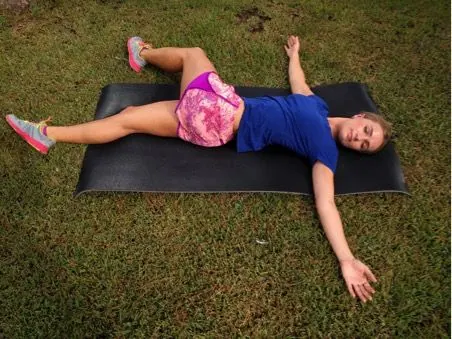
For this last at-home Pilates exercise for pregnant women, lie on your back with both legs straight and your arms open to the sides (palms facing up). Then lift one leg, bent, and take it across to the other side of the mat.
Turn your hips and rotate your spine so you can rest your foot on the floor. To give you an idea, the photo shows the stretch in the mid- and lower back muscles.
Important
- Keep both shoulders on the floor the whole time, as the aim is to rotate the whole spine and pelvis, stretching the mid- and lower back muscles.
- Turn your head in the opposite direction from your leg.
- Hold the position for 3 deep breaths and then switch legs.
- Repeat 5 times on each side.
Are there contraindications to these at-home Pilates exercises?
All women who want to do Pilates exercises for pregnant women at home should first get clearance from their doctor or physiotherapist.
As a general rule, though, the contraindications to exercising during pregnancy are:
- Acute cardiovascular disease.
- Rheumatic disease.
- Pulmonary embolism.
- Severe high blood pressure.
- Recurrent miscarriage or a shortened cervix.
- Uterine bleeding.
- Suspected fetal distress.
- Fetal growth restriction.
- Placenta previa or risk of premature birth.
- Acute infections.
- Extreme obesity.
There are also some situations in which pregnant women need specific guidelines to exercise:
- Diabetes
- Thyroid disease
- Anemia
- Multiple pregnancy
- Third trimester with the baby in breech position
- Hyperlaxity of the pelvic ligaments
Women who have never done sport or physical activity in the last year are advised to wait until the fourth month of pregnancy before starting prenatal Pilates exercises at home or any other physical activity.
On the other hand, first-time mothers or women who have had miscarriages in the past shouldn’t do any kind of sport until week 12 of pregnancy, as this is the most critical period, when miscarriages are most frequent.

Now that you know a Pilates routine to do at home, remember that the most important thing is for the woman to tell her gynecologist about any physical activity she wants to do. That way, potential risks during pregnancy can be eliminated and the mother’s health won’t be harmed.


Pilates classes for pregnant women in Valencia
Move safely during pregnancy in our Pilates classes for pregnant women, adapted to each trimester.