
Pelvic floor rehabilitation: how to avoid pain caused by unsuitable exercise



Article content
Physical exercise is essential for health and well-being for both men and women. That’s why regular sport is necessary to keep the musculoskeletal, cardiovascular and nervous systems in good shape and to prevent diseases such as diabetes, high blood pressure, heart attacks, arthritis, osteoarthritis or mental illness.
For women, because of their anatomy and physiology (pregnancies, births, menopause or menstrual cycles), sport requires special attention. Certain exercises are unsuitable for the pelvic floor, the group of muscles, ligaments and fasciae that closes the bottom of a woman’s body and supports the internal organs.
The pelvic muscles are exposed to many things that can weaken them, such as pregnancy, vaginal birth, excess weight, menopause, genital surgery or a chronic cough. If you add exercises that are unsuitable for the pelvic floor, the whole area is put at risk, which will lead to the need for pelvic floor rehabilitation.
But since this last factor is reversible, today I’ll talk about how to avoid pelvic floor pain so that, by changing your exercise habits, you can prevent or even reduce the symptoms of a pelvic floor injury.
If you have muscle discomfort during your pelvic floor training or everyday activities, Magnetic-Tape can provide extra relief by supporting the neuromuscular response and local blood flow.
Which exercises cause pelvic floor pain?
In sport there’s a group of exercises that are dangerous and make it more likely you’ll need pelvic floor rehabilitation. We can divide them into two types: high-risk sports activities and high-risk abdominal exercises. Both have in common the same factor that causes pelvic floor pain: increased intra-abdominal pressure.
Below I’ll explain which activities and exercises are most likely to mean you’ll need pelvic floor rehabilitation exercises.
-
High-risk activities
These are workouts that increase intra-abdominal pressure and push the diaphragm and internal organs downward, compressing the pelvic floor.
- Horseback riding
- Step
- Zumba
- Jumping (jump rope)
- Tennis, squash or padel
- Body pump classes
- Trampolining
- Track and field
- Weightlifting
- Aerobics
- Running

It’s important to stress that this isn’t about banning them, but about being aware that if we regularly do any of these activities, we must strengthen the pelvic muscles with other exercises, as I’ll explain later.
-
High-risk abdominal exercises
Harmful abdominal exercises are those that involve bringing the shoulders toward the hips (or the other way around: hips toward shoulders). They create a downward and forward push that makes the belly “push out” instead of “draw in.” In other words, they push the internal organs (those suspended in the trunk) downward, increasing the risk of genital prolapse, incontinence or a weakened perineum; in the latter case, perineal massage would be needed.
These exercises, which will lead to the need for pelvic floor recovery, increase the risk of herniated, bulging or compressed spinal discs and, as a result, lower back pain, mid-back pain, sciatica, etc.
Here are examples of high-risk abdominal exercises that are often done in gyms, some Pilates and aerobics classes, or at home:
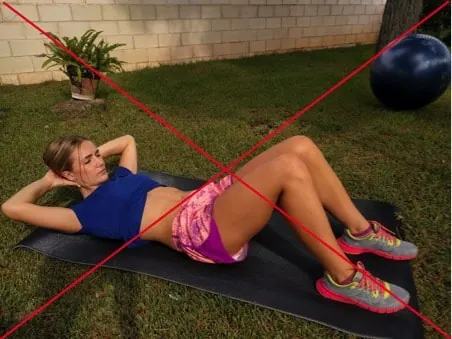
Abdominal exercise for the rectus abdominis
This contraindicated exercise involves lifting the head and neck to activate the abdominal muscles. It’s very common in Pilates classes or any group class in gyms, and it could cause the internal organs to descend and weaken the perineum.
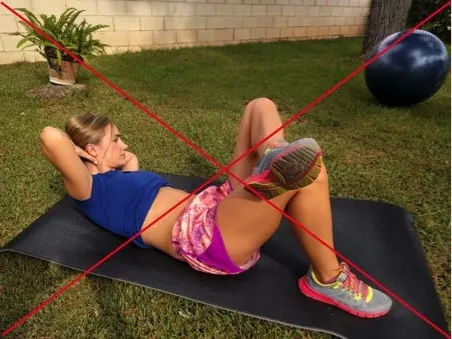
Abdominal exercise for the obliques
This other contraindicated exercise involves lifting the head and neck and rotating the trunk, bringing the shoulder toward the opposite leg. It activates the oblique muscles and causes a dramatic increase in pressure. If the obliques contract together with a crunch of the rectus muscles (as in the photo), they contribute to relaxing the pelvic floor and the transverse abdominis, the muscle that protects and stabilizes the spine.
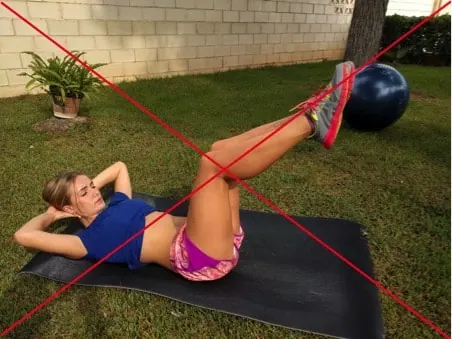
Abdominal exercise with leg raises
In this other practice that’s harmful to the pelvic floor, you keep your legs raised (bent or straight) and, as you breathe out, lift your head and neck. It’s a very harmful exercise, as it puts great compression on the organs and pushes them downward.
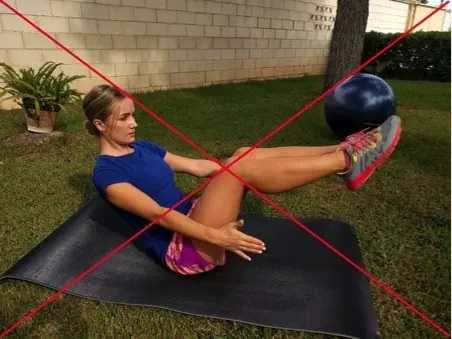
Exercises in the hundred position
This is another very common exercise in Pilates and/or yoga classes, especially in more advanced groups, and I don’t recommend it. Sitting, you lift your legs (bent), stretch your arms forward and keep your back straight.
Often a progression is added in which you straighten your legs and hold your trunk and legs up in a “V” shape. The diaphragm is pushed down, the abdominal muscles are tense and the pelvic floor is compressed. It’s practically impossible to activate the pelvic floor in this position, and there’s a lot of compression on the genitals. If this kind of exercise is done continuously over a long period, it can eventually cause pelvic floor pain.
What happens in our body when we increase intra-abdominal pressure?
If you do sports that require normal breathing, without excessive effort, there’s hardly any change in pressure in the abdomen. But if you make efforts with full lungs and a locked diaphragm, intra-abdominal pressure increases dramatically. For example, when you bend your trunk forward or when your feet hit the ground, as when we go running, as I’ve explained.
In short, exercises that strengthen the abs should never be combined with the diaphragm descending, as happens with impacts, bending the trunk, flexing the spine forward or lifting weights.
So when you do pelvic floor rehabilitation, the aim will be to reduce the negative consequences of abdominal hyperpressure, which are significant, especially for the internal organs suspended in the trunk: bladder, uterus and rectum. These are pushed down onto the pelvic floor and abdominal muscles, causing discomfort and making pelvic floor recovery necessary.
When the diaphragm descends, the pelvic floor and abs bulge and stretch. If this happens repeatedly, the muscles can become exhausted, overstretching and losing their role of supporting and protecting the spine and internal organs. As a result, urinary incontinence, bulging spinal discs, lower back pain, genital prolapse, rectus diastasis or leakage of gas and/or stool can appear.
5 pelvic floor rehabilitation exercises
There’s still a general lack of awareness about how harmful the exercises we’ve seen can be, so you may be one of many women who have done them for a long time and now need pelvic floor rehabilitation.
My first piece of advice is to have a pelvic and abdominal muscle assessment. It should be done by a physiotherapist specializing in gynecology and is needed to determine the degree of muscle weakness or dysfunction.
If you leak urine, gas or stool, notice a bulge in your vagina, feel that your abdomen swells easily, have trapped gas or notice that your rectus muscles have separated, you may have significant muscle dysfunction and need specific treatment.
Gynecological pelvic floor rehabilitation after high-impact sports or high-risk abdominal exercises is carried out through:
-
Hypopressive abdominal exercises
Hypopressive exercises reduce pelvic and abdominal pressure, causing an upward movement of the internal organs and a reflex contraction of the abdominal and pelvic floor muscles.
If you like running, playing tennis, doing Zumba or aerobics and don’t want to give these activities up, you’ll need to do hypopressive exercises regularly. Only through low-pressure exercises will you be able to balance changes in abdominal pressure and prevent pelvic floor pain.
One example of this type of exercise is standing hypopressive abs, like the one in the image:
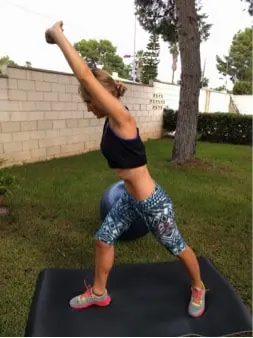
Standing with one leg forward, lean your trunk forward and stretch your arms up to form a diagonal line. The breathing technique starts with a deep breath in; then, after letting all the air out, force your ribs open while holding your breath (without breathing in again), holding it for up to 10 seconds.
This exercise creates a vacuum in the abdomen, an upward movement of the organs and works the pelvic and abdominal muscles.
-
Isometric abdominal exercises
They’re completely safe and don’t increase intra-abdominal pressure the way traditional sit-ups do. These are exercises in which the spine stays lengthened and neutral and the shoulders stay away from the hips; in other words, the shoulders and hips don’t move toward each other. In addition, these pelvic floor rehabilitation exercises can be done in several positions: lying on your back, on your side, on your front or on all fours.
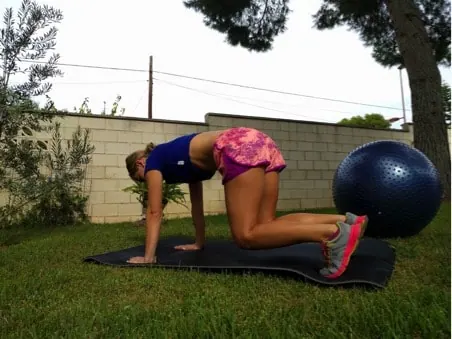
One of them is the isometric abdominal exercise on all fours, as you can see in the following image:
In this exercise, lift your trunk by raising your knees off the floor (about 3 cm, just over an inch), keeping your shoulders and hips at the same height. This activates the transverse abdominis, which is very beneficial for looking after the pelvic floor and spine and will help with pelvic floor recovery.
-
Postural re-education
This means improving your posture throughout the day; in other words, doing everyday activities with good body positioning and avoiding increases in pressure from lifting weight with poor posture.
To do this, try to keep your spine as long and straight as possible, stand or sit with your spine lengthened and never bring your breastbone toward your pubic bone (for example, avoid bending down by curving your spine).
Self-lengthening of the spine reflexively activates the abdominal and pelvic floor muscles and keeps the diaphragm in its correct position.
-
Vaginal electrical stimulation
This is a type of treatment done in the gynecological physiotherapy clinic in cases of loss of pelvic floor strength (incontinence). Vaginal electrical stimulation creates a low-intensity electrical current that makes the muscles contract and also stimulates local blood flow. All of this helps the perineum get stronger faster.
-
Using Kegel balls or vaginal cones
This last pelvic floor rehabilitation exercise, using Kegel balls or vaginal cones, helps activate the muscles around the vagina. These tools are also helpful both in clinic sessions and at home. With them, you can work on muscle tone and strength, reducing leakage of urine, gas and stool.
In addition, Kegel balls can be used after giving birth to improve the condition of the pelvic floor.
In conclusion, whether because of “trends” or lack of awareness, many women do sports that can make pelvic floor problems worse. Prevention is always the best way to avoid injury, but even if injury does happen, there’s still time to turn things around. To do this, we can turn to exercises such as hypopressive abs or the help of techniques and tools such as electrical stimulation or Kegel balls.


Get your pelvic floor checked in Valencia
Something doesn’t have to go wrong: with a pelvic floor check-up we see how it is and what you should do. Can’t come to Valencia? We also see patients in an online consultation.