Why vulval varicose veins appear in pregnancy and how you can prevent them



Article content
A feeling of heaviness in the legs, pressure in the calves and even varicose veins in the legs are common symptoms during pregnancy. They’re caused by greater dilation of the blood vessels in the calf area, which happens in 40% of pregnant women.
Varicose veins aren’t limited to the legs: they can also appear in the genital area. In pregnancy, it’s common for one of the labia majora to become misshapen and for vulval varicose veins to appear, but perhaps because of a lack of knowledge or information, they tend to be more frightening than those on the legs.
To raise awareness of what vulval varicose veins are, why they appear and how to treat them, I’ve written this article.
How can I tell if I have vulval varicose veins?

Practically all cases of genital varicose veins in women appear during pregnancy. We very rarely see them in women who aren’t pregnant. So, in most cases, these varicose veins disappear completely after giving birth.
Vulval varicose veins look almost the same in all pregnant women. It’s common to see:
- Purple (violet) lumps on the vulva.
- Visible dilated veins on the labia majora.
- Asymmetry (they usually appear on one of the labia majora).
- Swelling of the vulva.
- Redness of the perineum.
- Pain on touch and hypersensitivity of the vulva.
- A burning or hot feeling in the perineum.
- Discomfort when sitting for a long time or during sex.
What causes vulval varicose veins in pregnancy?
The main cause is venous insufficiency in the pelvic area and the pressure the baby puts on the venous plexuses of the pelvis. During pregnancy the volume of blood circulating in the blood vessels increases and, in addition, progesterone makes the blood flow more slowly. These factors increase the risk of varicose veins in the lower body (hemorrhoids, vulval varicose veins, varicose veins in the legs).
Vulval varicose veins usually appear from week 25–30 of pregnancy, when the baby is already a significant size. Women who are prone to varicose veins, have a family history or are overweight are at the greatest risk. If you’re worried about whether vulval varicose veins go away after pregnancy, the good news is that after giving birth, in most cases, they disappear almost completely and spontaneously, without any treatment.
What can we do to ease the discomfort of vulval varicose veins?

The most important thing is prevention. If we’re in the risk group, that is, if we have poor circulation, we should take care from the start of pregnancy and change certain habits. Preventing vulval varicose veins is based on a good diet, good posture and regular exercise. We recommend following these guidelines:
- Avoid processed and sugary foods, too much coffee and white flour.
- Drink at least 2 liters of water a day.
- Eat vegetables daily (especially leafy greens).
- Exercise regularly (at least 150 minutes of physical activity a week).
- Do pelvic floor exercises.
- Avoid sitting on hard surfaces (use a Pilates ball as a chair).
- Don’t wear very tight underwear.
- Try to have a bowel movement every day.
Remedies to ease vulval varicose veins in pregnancy
Women with vulval varicose veins should follow these guidelines to ease the discomfort:
- Apply cold to the perineal area.
- Use a pelvic support belt, which helps take pressure off the pelvic area.
- Wear compression stockings every day.
- Rest on your left side.
- Lie down with your legs raised every day, for at least 20–30 minutes.
- Use a toilet stool to make bowel movements easier.
- Gently massage the perineal area using special oils.
More about vulval varicose veins and the pelvic floor
Practicing Kegel exercises for women can be very helpful in preventing vulval varicose veins and hemorrhoids. Contractions of the perineal muscles boost circulation in the blood vessels and stop blood from pooling in the vulva. We recommend doing Kegel contractions in positions with the pelvis slightly raised, as in this example:
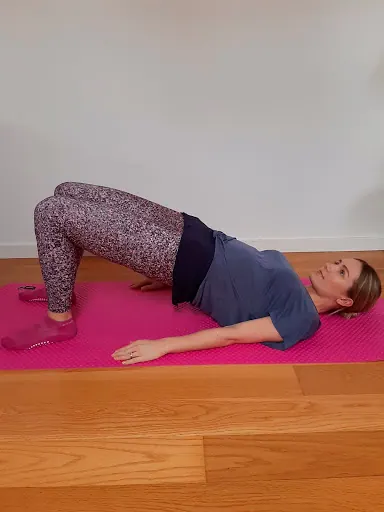
Lying on your back, lift your hips toward the ceiling. Keeping your trunk raised, do 15 slow pelvic floor contractions. As you breathe out, close your sphincters and hold the contraction for 10 seconds. Then lower your spine to the floor one vertebra at a time.
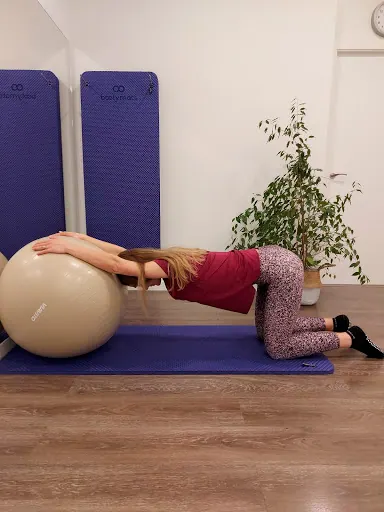
Get down on all fours and rest your arms on the Pilates ball. Keep your hips just above your knees and your spine straight. Do 5 sets of 10 fast Kegel contractions: as you breathe out, do 10 contractions as fast as you can. Repeat for 5 sets. Between sets, you can lower your hips and rest them on your feet.
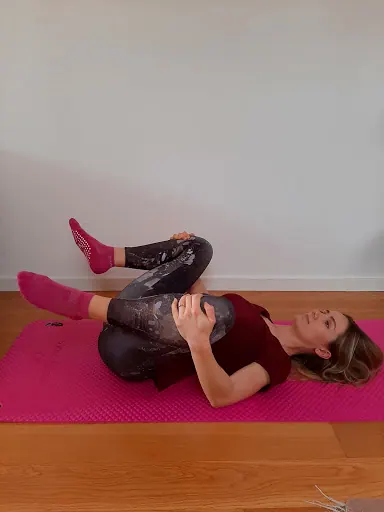
Lying on your back, bring your knees to your chest and hold them with each hand. Move them apart to make room for your bump. Do 15 slow pelvic floor contractions, holding each for 10 seconds: as you breathe out, contract your sphincters and hold for 10 seconds. Then lower your feet to the floor.

We can help with vulval varicose veins in Valencia
We give you exercise and guidelines adapted to your pregnancy with physiotherapy for vulval varicose veins. Can’t come to Valencia? We also see patients in an online consultation.