
Complete Pilates workout with resistance bands for pregnant women



Article content
An active pregnancy is essential for a woman’s body to be ready to give birth. During the nine months of pregnancy, the abdomen grows, the pelvis widens and the muscles change their tone. That’s why training during pregnancy helps you cope better with all these changes. As I’ve written before, Pilates is one of the most recommended activities during pregnancy, and in this article we specifically propose a Pilates exercise routine with resistance bands for pregnant women.
The best time to start this Pilates routine is at the beginning of the second trimester, in week 12 of pregnancy. If our gynecologist hasn’t advised against exercise, from then on we can sign up for activities for pregnant women. Pilates for pregnant women in particular is a method built around exercises focused on the muscle groups that weaken most during pregnancy: the pelvic floor, the abdominal muscles and the muscles that support the spine.
I’ve chosen resistance bands for this Pilates routine because they help us build more muscle strength. It’s always a good idea to do mobility, flexibility and toning workouts, but many pregnant women neglect resistance strength training, even though it’s just as important in preparing for birth. When a muscle gains mass and strength, it’s much more resistant to effort, overstretching or the weakening caused by hormones that’s so common in pregnancy.
10 resistance band exercises for pregnant women
1. Strength work for the legs, arms and abdomen:
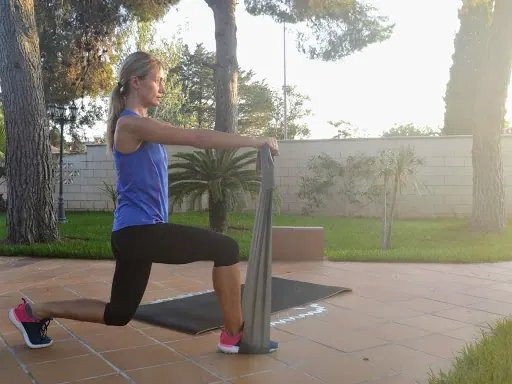
Photo 1: Leg bend with resistance
This exercise works the strength of the leg, arm and abdominal muscles. And by controlling your posture, you’ll also work the muscles that stabilize the spine.
Standing, place your right leg in front and your left leg behind. Step on the band with your right foot to get medium resistance, and hold the ends firmly with both hands.
Take a deep breath and, as you breathe out, bend both knees to 90 degrees and pull the band tight (raising your straight arms). Come back up as you breathe in. Repeat 8 to 10 times on each leg.
It’s important not to lean your trunk forward and to keep your spine straight the whole time. Your arms stay straight and your shoulders away from your head.
2. The ‘V’:
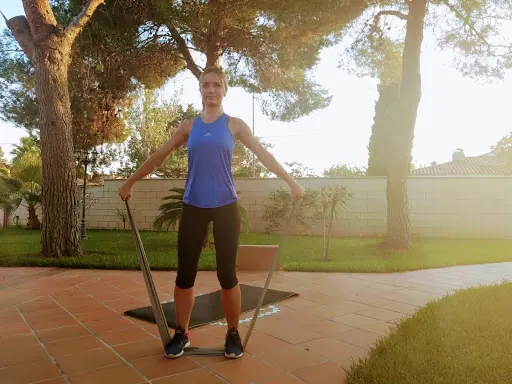
Photo 2: Arm exercise known as the ‘V’.
Building up the shoulder and arm muscles is very important during pregnancy. It prepares the shoulder joints and shoulder blades for breastfeeding and for all the carrying you’ll do postpartum. The stronger your arms, the fewer neck problems you’ll have when breastfeeding your baby.
Standing with your ankles hip-width apart, step on the band with both feet and hold it with both hands. Keep your arms straight alongside your trunk. Bend your knees slightly so you don’t overload your lower back.
Take a deep breath and, as you breathe out, open your arms in a ‘V’ shape, pulling the band tight. Breathe in and relax. Make sure your shoulders don’t rise toward your ears as you lift your arms. It’s important to keep your spine lengthened and look straight ahead. Repeat this exercise from the Pilates routine 10 to 15 times.
3. Squats:
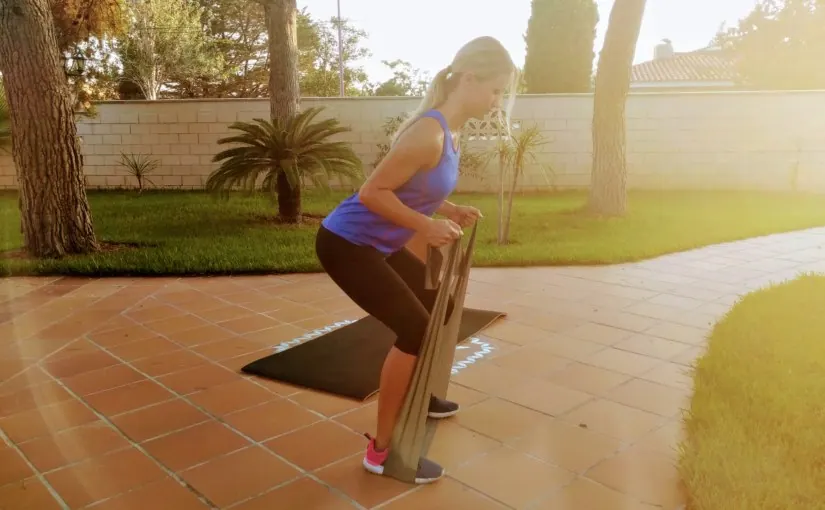
Photo 3: Squat
This exercise strengthens the glute muscles. It’s important to tone the back of the legs, especially the glutes. With good tone in these muscles we prevent pelvic floor problems: our pelvis sits in its natural (neutral) position and the pelvic floor muscles work correctly. In the same exercise from this Pilates routine, we can also work the biceps.
Standing, step on the band with both feet (hip-width apart), hold the ends of the band with both hands and stretch your arms down. Take a deep breath and, as you breathe out, squat, bending your legs and elbows (pulling the band tight). It’s important that your knees don’t go past your toes and that your elbows stay close to your trunk. Keep your spine lengthened during the exercise. As you breathe in, return to the starting position. Repeat 10 to 15 times.
If you’re in the third trimester and your growing bump makes this exercise uncomfortable, here’s a modification that will probably suit your needs better.
3b. Wide-stance squat (3rd trimester):
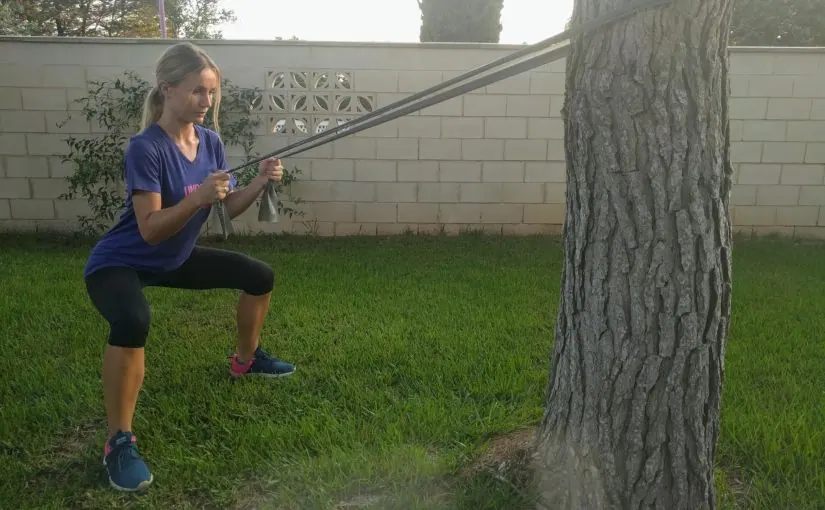
Photo 3b: Wide-stance squat
If you’re in the third trimester of pregnancy, this version of the squat may suit you better, so you can add it to your Pilates routine. In this case, we’ll anchor the band to a tree or something sturdy (a column, etc.) and do it with our legs further apart.
Start with your feet slightly wider than hip-width apart (wide enough that you can lower your pelvis without feeling discomfort in your lower abdomen). Hold the ends of the band with both hands and stretch your arms down.
Take a deep breath and, as you breathe out, bend your knees and lower your pelvis as far as you can (without your knees going past your toes). At the same time, pull the band tight by bending your elbows, keeping them close to your trunk. As you breathe in, return to the starting position. Repeat 8 to 12 times.
4. Exercise with a resistance band and Pilates ball:
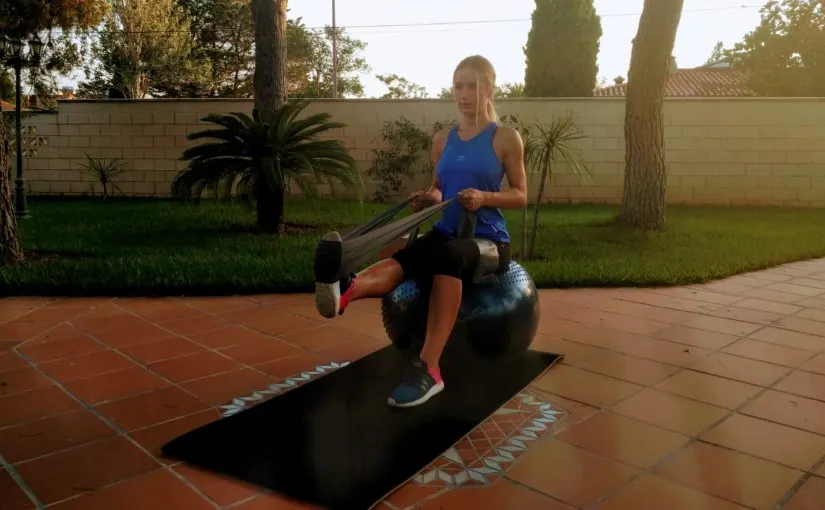
Photo 4: Exercise with the resistance band and fitball
In this exercise we work the strength and power of the quadriceps and at the same time activate the transverse abdominis and all the back muscles.
Sitting on the large ball, hook the band around your straight right foot. Hold the ends of the band with both hands and bend your elbows. Take a deep breath and, as you breathe out, stretch your right leg forward (without changing the position of your arms). The aim is to keep your balance, straighten your right knee completely and at the same time hold your pelvis in neutral. This will activate the deep muscles of the abdomen and back. Repeat up to 10 times on each leg.
5. Side stretch:
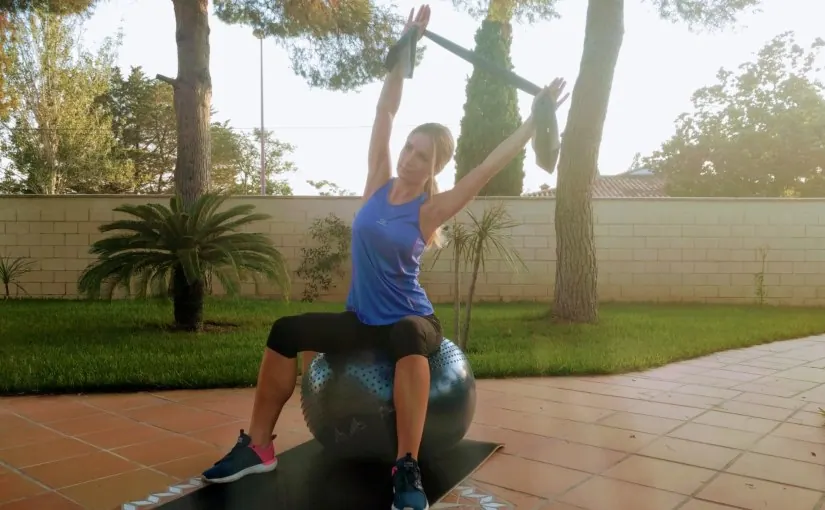
Photo 5: Side stretch of the trunk
It’s necessary to stretch between strength exercises to keep the muscles from getting tired. That’s why, after the previous exercises, we’ll add a stretch for the side of the trunk to our Pilates routine.
Sitting on the ball, with your feet as wide apart as the mat, raise your arms holding the band. Hold your wrists wider than shoulder-width apart so the band is gently taut.
Breathe in and, as you breathe out, lean your trunk to one side without changing the position of your pelvis. Breathe in as you come back to the center and, as you breathe out, lean to the other side. Repeat up to 10 times on each side.
6. Leg circles:
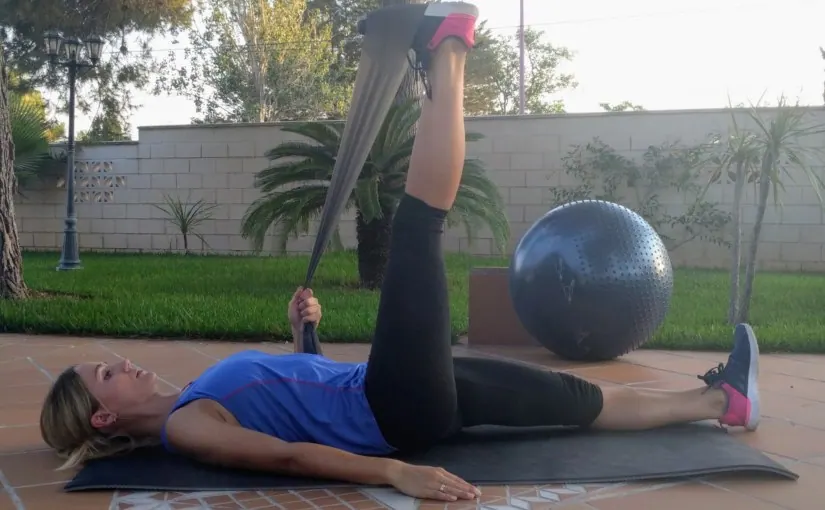
Photo 6: Circular leg movement
The aim of this exercise is to strengthen the deep hip muscles. Make circles with your straight leg, with the band hooked around your foot to add resistance.
Lying on your back, raise your right leg and put the band around your foot. Hold both ends of the band with the opposite hand. Stretch your other leg out on the floor and relax it. Make circles with your raised leg, trying to keep your pelvis still. Do eight circles outward and the same number inward. Then switch legs.
7. Shoulder bridge with resistance:
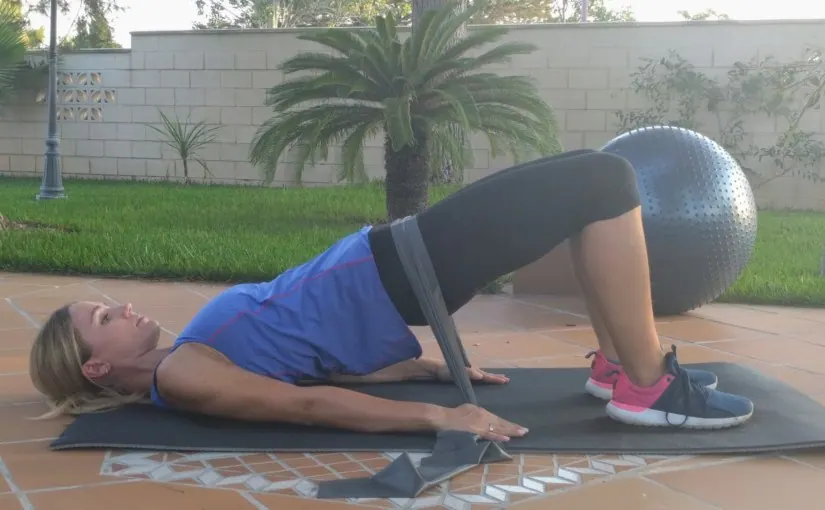
Photo 7: The shoulder bridge
It’s the most typical exercise in any Pilates routine and very beneficial for pregnant women. It activates the deep muscles of the pelvis, mobilizes the spine and tones the glutes. If we add resistance with the band, we’ll activate the muscles at the back of the legs even more.
Lying on your back with your legs bent, place the band across your pelvis, below your pubic bone.
Take a deep breath and, as you breathe out, lift your hips and spine. Press the ends of the band down with your hands so they don’t lift off the floor. Lift your pelvis as high as you can, pulling the band as tight as possible. Breathe in with your trunk raised and, as you breathe out, lower your spine to the mat. Repeat up to ten times.
8. Core work on all fours:
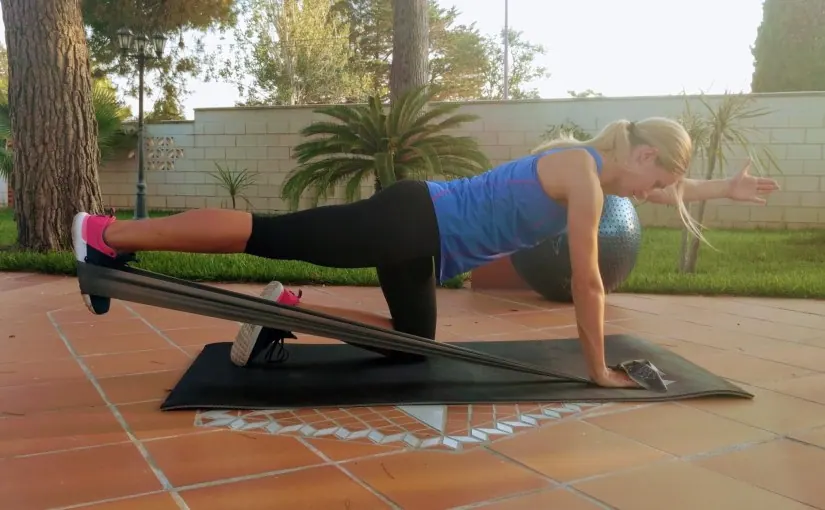
Photo 8: Core exercise on all fours
This exercise is also common in Pilates classes and, personally, it’s one of my favorites, so it’s ideal for a Pilates routine. The inverted position, on all fours, is a position that helps us activate the deep abdominal muscles better. By stretching out the opposite leg and arm, we add an element of instability that makes this exercise even more complete.
Start on all fours. Hook your right foot into the band, stretch your leg back and hold the ends of the band down with your right hand. Lift your leg carefully, feeling the tension in the band and a strong contraction of the glute muscles. Stretch your opposite arm forward and hold the position for 10 seconds. During this time, find your balance by activating your transverse abdominis (drawing your belly in). Switch sides and repeat the exercise.
9. Spinal rotation:
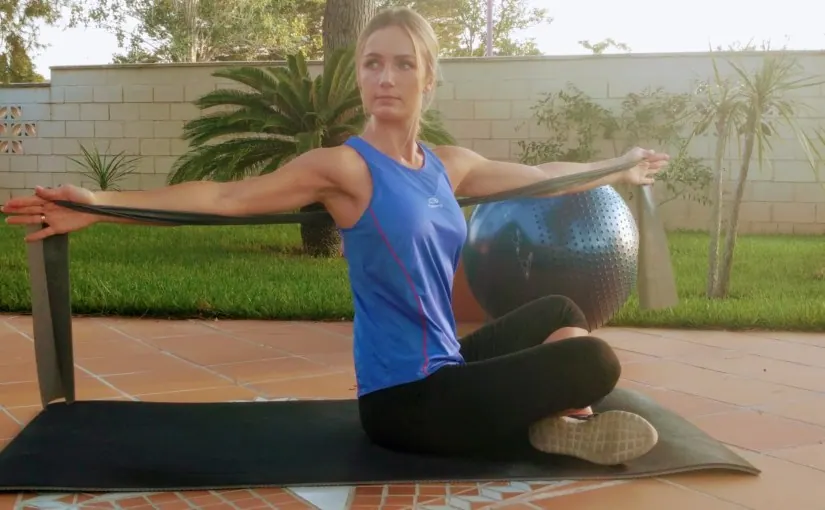
Photo 9: Trunk twists
Spinal rotation is necessary in the first months of pregnancy, as in the last weeks it will be very limited. Trunk twists with your arms open stretch the chest and mobilize the intercostal muscles and vertebrae.
Sitting cross-legged, hold the ends of the band with both hands and open your arms out to the sides. Draw your shoulder blades together behind you and keep your shoulders away from your ears.
Take a deep breath and, as you breathe out, turn your trunk to one side (rotating your whole spine and your head too), always keeping your arms in a line. Breathe in as you come back to the center and, as you breathe out, turn to the other side. Repeat up to 20 times.
Remember that this Pilates routine with resistance bands is designed for pregnant women with no contraindications to exercise. All the exercises are completely safe and suitable to do at home or outdoors, after a prior assessment by a physiotherapist specializing in the pelvic floor. The assessment is essential to rule out problems such as urinary incontinence, genital prolapse, leaking gas, lower back pain or sciatica.
If we have any of these conditions, not all the exercises shown can be done. The advantage of the prenatal Pilates method is that each exercise has many modifications that can be applied to each patient/student.
I hope you can do them at home and make the most of your active pregnancy!


Pilates classes for pregnant women in Valencia
Move safely during pregnancy in our Pilates classes for pregnant women, adapted to each trimester.