Respiratory physiotherapy: exercises to connect your pelvic floor and your breathing



Article content
Breathing isn’t just essential to our existence. In some ways, this bodily activity also affects the health of the pelvic floor muscles and therefore our overall well-being.
We want to explain the amazing connection between the pelvic floor and breathing. To do so, we bring you a series of respiratory physiotherapy exercises to follow.
Most of us pay no attention to our breathing until some kind of problem appears. Maybe after a great physical effort we feel more out of breath than usual, or even when we feel some strong emotion.
The same happens with the pelvic floor. We don’t pay attention to it until we have some urinary incontinence. In previous posts we’ve recommended different exercises to improve your pelvic floor. Now we want to explain the connection between the pelvic floor and breathing, with a series of respiratory physiotherapy instructions to follow to improve your quality of life.
Respiratory physiotherapy exercises
Breathing into the sides of the rib cage
In Pilates classes, one of the main instructions from the specialist or instructor will be to breathe into the sides of your rib cage. It’s a very common cue. It may seem like a metaphor for conscious, active breathing, and it really is.
Breathing literally affects the pelvic floor and abdominal muscles. Deep breathing benefits the pelvic floor muscles, the diaphragm and the abs.
Remembering the anatomy of the pelvic floor, we know that it’s a structure stretched between the sit bones (the bones in your bottom), the coccyx and the pubic bone. The layers of the pelvic floor ‘hang’ like a hammock at the base of the pelvis, supporting the internal organs (bladder, uterus, intestines).
How breathing in affects the pelvic floor
Proper breathing is absolutely necessary to keep the pelvic floor healthy. Our most important breathing muscle is the diaphragm.
It’s dome-shaped and constantly moves up and down. When we breathe in through the mouth or nose, the lungs and ribs expand. The diaphragm moves down, pushing everything in its way: the internal organs.
And where are the internal organs pushed? Onto our pelvic floor. When we breathe out, the ribs close, the diaphragm rises and the internal organs move up too.
This is why breathing is so important in pelvic floor work. Healthy perineal muscles stretch as we breathe in and contract as we breathe out.

The importance of the abdominal muscles
We’ve looked at the connection between the diaphragm and the pelvic floor. But there’s another key factor in healthy pelvic floor function: our abs.
The most important is the transverse abdominis. It’s the deepest muscle, wrapping around our trunk like a corset. Its fibers run horizontally, which means that when they contract, they pull in around the abdomen (think of tightening a belt).
If we have poor postural habits or sit for many hours at work, our transverse abdominis will be weak. This can be linked to pelvic floor problems.
For example, we often sit ‘slumped’, rounding our whole spine into a C shape. This makes it very hard to breathe deeply, so the pelvic floor muscles don’t get the exercise they need, that is, stretching and contracting with each breath in and out. In short, if we don’t breathe correctly, our pelvic floor suffers.
How can you breathe more deeply?
Changing breathing habits isn’t easy, and the key is never to force it. But we can train our breathing muscles with a simple respiratory physiotherapy exercise, and little by little it will become easier to make it part of our daily routine.
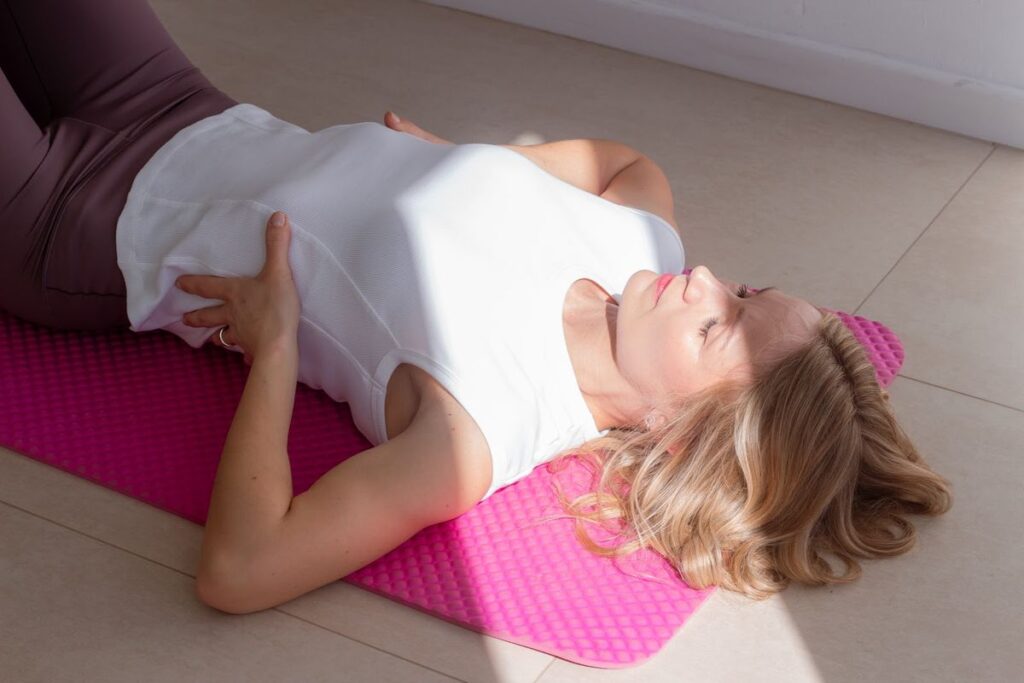
- Lie on the floor and rest your legs on a large ball or a chair. To focus more on the pelvic floor, bend your knees, let them fall open and bring the soles of your feet together.
- To begin, take a few minutes. Listen to your body and notice the rhythm of your breathing and the movement of your rib cage and abdomen. Don’t try to change anything; just observe.
- Place your hands on your lower ribs (on the sides of your rib cage). As you breathe in, let your belly relax and soften.
- Feel your ribs open and your whole rib cage expand. Try to breathe into the area under your hands. As you breathe out, gently contract your transverse abdominis, drawing your belly button in and up.
- Notice what’s happening in your pelvic muscles. See whether there are areas of tension and whether you can locate them. Repeat 5 to 10 times and then return to normal breathing.
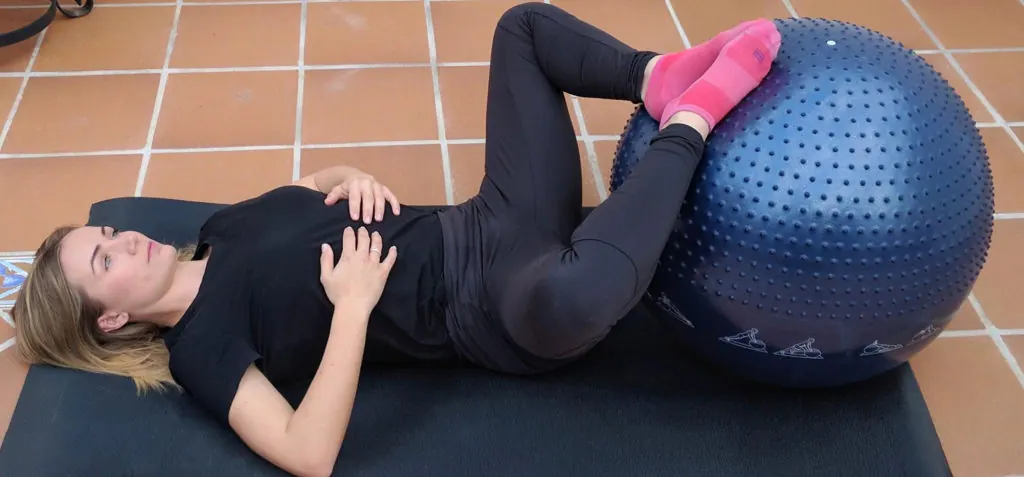
Doing this respiratory physiotherapy exercise every day will help normalize the tone of your pelvic muscles. If there’s too much tension, deep breathing will help them stretch and relax.
If pelvic tone is low, practicing this exercise will improve it. You’ll also normalize tension in the diaphragm, which will have a positive effect on the health of your whole body. One way to learn to contract and relax the pelvic muscles correctly, or check whether your pelvic floor strength and tone are right, is to do the exercise with the Epi-No device. It’s a biofeedback device that lets us measure the strength of the pelvic muscles. With the probe (balloon) in the vagina, when we do Kegel exercises we can see the needle move on the gauge. If we can contract the pelvic floor and move the needle from 0 to 4, that’s the right strength. If we can’t contract up to “4”, our pelvic floor may be weak and we should see a specialist.
Bladder control through breathing
Many of my patients have symptoms of urge urinary incontinence, chronic pelvic pain, constipation, vaginismus and a feeling of incomplete emptying. At the same time, they have a lot of tension in both the pelvic floor muscles and the diaphragm.
When we feel a strong urge to go to the bathroom, the most common reaction is to stop breathing and squeeze the abdominal muscles hard. This creates even more pressure inside the abdomen and triggers uncontrolled bladder spasms.
Patients notice an improvement when they learn how to relax the diaphragm at moments of urgency and how to lower the tension in the pelvic muscles to reduce pain, such as a constant feeling of pressure in the pelvis, or to lengthen the time between trips to the bathroom.
We recommend that all of you practice deep breathing. It’s an absolutely necessary technique to help you feel better, with less anxiety and stress.


Get your pelvic floor checked in Valencia
Something doesn’t have to go wrong: with a pelvic floor check-up we see how it is and what you should do. Can’t come to Valencia? We also see patients in an online consultation.