Pilates for pregnant women as a way to prepare for birth



Article content
Pilates is a training method based on exercises that focus on strengthening all the muscles of the body and on overall stretching. Every single movement in Pilates for pregnant women is accompanied by rib cage breathing, as the aim is to coordinate correct technique with breath control, working body and mind at the same time.
Why should you do Pilates during pregnancy?
In our classes, we use a personalized method with an initial assessment of each student, recommending exercises adapted to each pregnant woman’s needs. Wherever you practice, it’s very important to check with a specialist which exercises you can do and which are not advised.
The main goals you’ll achieve by doing Pilates during pregnancy include:
- Better posture and awareness of the right positions for everyday activities such as walking, lifting, sitting… This reduces the intensity of muscle aches and knots.
- Strengthening the arm muscles to prepare the body for the demands of caring for the baby.
- Toning the pelvic floor to prevent postpartum dysfunctions such as urinary incontinence.
- Toning the deep abdominal muscles to prevent postpartum diastasis.
- Cardiovascular stimulation.
- Stretching the lower back and glute muscles to prevent sciatica-related discomfort.
- Keeping good mobility in the pelvic joints, which will help during birth.
- Learning to relax the pelvic floor muscles.
- Becoming aware of breath control and its relaxing effect.
Among the basic principles of Pilates for pregnant women, several stand out:
Breathing: the powerhouse concept
According to Joseph Pilates, the creator of the method, the center of strength is located in the torso, ribs, pelvis and abdomen. When we breathe in we should open our ribs as much as possible, and when we breathe out we actively close the ribs to activate the deep muscles of the trunk.
The transverse abdominis is the deepest of all the abdominal muscles and wraps around the trunk like a natural corset that supports the spine and pelvis. It contracts in practically every exercise. It’s activated as you breathe out, as we explain in this pelvic floor exercise guide.
Correct activation of the pelvic floor muscles is also part of the so-called powerhouse, because its work should always be synchronized with the activation of the transverse abdominis.
Pelvis in neutral
This position allows the spine to be correctly aligned, and we should keep it throughout our Pilates work. Standing, if we place our hands (forming a triangle) on the front of the pelvis (the pubic area), this triangle should be flat. If we’re lying on our back, the lower back shouldn’t rest on the floor and the triangle formed by our hands should be parallel to the floor.
For more information, see the images in the Kegel routine for women.
Choosing the program according to the stage of pregnancy
In the first trimester there’s a higher risk of miscarriage, so we shouldn’t start Pilates exercises yet. Physical activity is limited to walks and Kegel exercises.
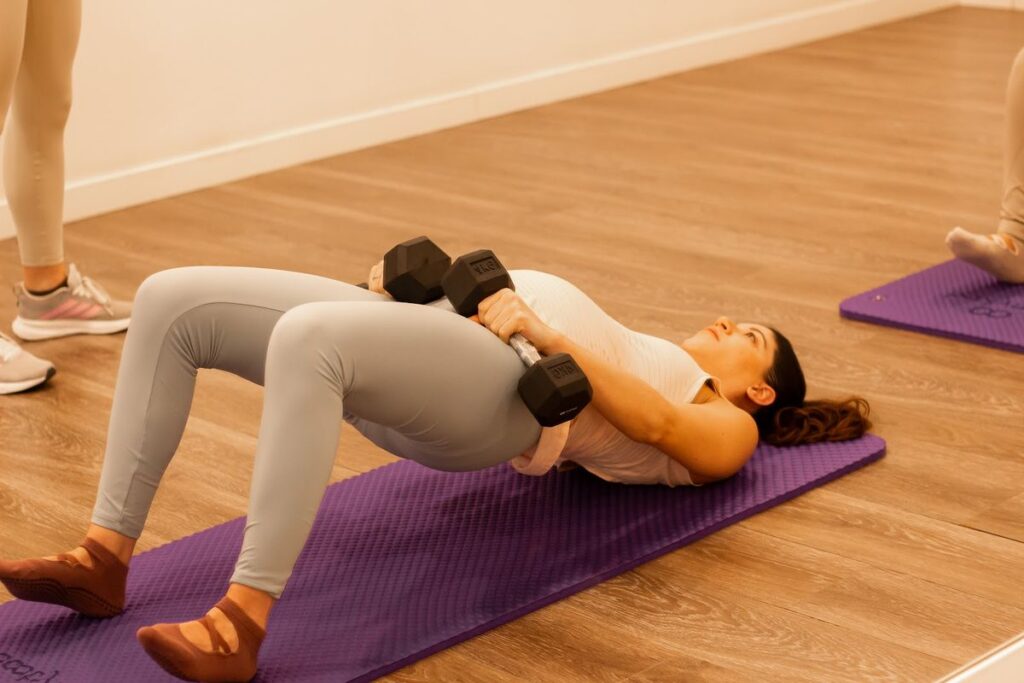
The second trimester is the best time to start Pilates for pregnant women. More exercises focus on toning the pelvic floor and transverse abdominis. They can be done in different body positions: lying on your back, on your side, sitting, on all fours, standing.
It’s a good time to tone the back and arm muscles, as in the third trimester it will be harder because of the size of the bump and tiredness.
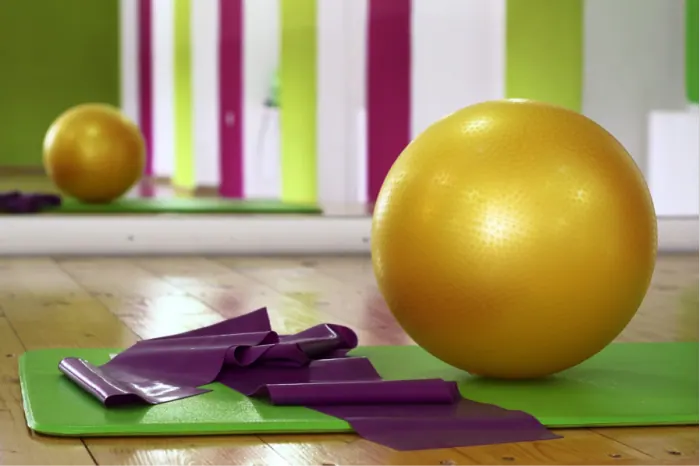
In the third trimester, exercises that increase pelvic and lower back mobility are recommended. Fitballs, small soft balls, foam rollers, etc. are used. These exercises help the baby settle into the right position. More breathing exercises and stretches are done.
Finally, in this last stage pregnant women suffer more from back pain, sciatica, piriformis syndrome or migraines. Gentle exercises combined with rib cage breathing, in a pleasant environment, help get through the hardest weeks of pregnancy. In this stage, using pelvic support belts is also highly recommended.
Are there contraindications to Pilates for pregnant women?

Yes, women with these conditions shouldn’t do Pilates during pregnancy:
- Acute myocardial disease
- Severe high blood pressure
- Rheumatic disease
- Pulmonary embolism
- Thrombophlebitis
- Congestive heart failure
- Previous miscarriages
- Uterine bleeding
- Placenta previa
- Suspected fetal distress or growth restriction
- Risk of premature labor
- Extreme obesity
Other medical conditions require an individual assessment before doing Pilates in pregnancy, and if the exercises are allowed, they may be done with special guidelines. This applies to women with:
- Diabetes
- Anemia
- Thyroid disease
- Multiple pregnancy
- Essential hypertension
Where is the best place to do Pilates exercises for pregnant women?
Bear in mind that before starting any physical activity during pregnancy you should talk to a doctor. If you have no contraindications, the next step is to find out whether a qualified specialist works at the center you want to go to. In my case, I teach Pilates for pregnant women in Valencia.
Depending on the center, Pilates classes for pregnant women can be private, semi-private or in groups. If you’ve never done Pilates, you should start with private classes or small groups to learn the technique, breathing, etc.
Most importantly, before signing up for group or individual classes, ask for an initial assessment that examines your spine, joint mobility, muscle tension and the condition of your pelvic floor, so your training can be personalized.


Pilates classes for pregnant women in Valencia
Move safely during pregnancy in our Pilates classes for pregnant women, adapted to each trimester.