Perineal massage guide: professional recommendations and benefits



Article content
Centuries ago, midwives used perineal massage during labor to help the baby’s head come out and to reduce the risk of tearing or episiotomy.
It’s still practiced today and is highly recommended in developed countries. But always under the supervision of a professional.
What are the benefits of perineal massage?
It helps prevent perineal tearing and/or an episiotomy (the vaginal cut), one of the most feared possible complications of a vaginal birth. It’s worth knowing that it hasn’t been scientifically proven that perineal massage completely prevents the vaginal cut.
What is true is that massaging the perineum softens the tissue and makes it more flexible. This improves circulation and oxygenation in the superficial pelvic floor muscles. Even more interesting, it helps you ‘get used to’ the stretching sensation.
This last point is the most important because by stretching and pressing on her vagina, the pregnant woman gets to know the sensations she will feel during birth. It’s what professionals call ‘biofeedback’, a tool that almost always increases the therapeutic effect.
When is it recommended?
This massage is recommended for pregnant women, to prepare for birth. It can also be helpful for women who have had an episiotomy during birth.
At the time of birth, the new protocols advise professionals to perform an episiotomy only in these cases:
- Instrumental deliveries.
- Risk to the baby’s life.
- A large baby compared with the size of the mother’s pelvis.
In other cases, labor should be allowed to flow. The woman should be free to move and choose her positions and, above all, have the support of the staff caring for her.
When can you start perineal massage during pregnancy?
You can start from week 35. This is a standard protocol throughout the European Union, aimed at avoiding the risk of premature labor. Also, from that week on, the perineum has already adapted to the changes of pregnancy and the massage is more effective.
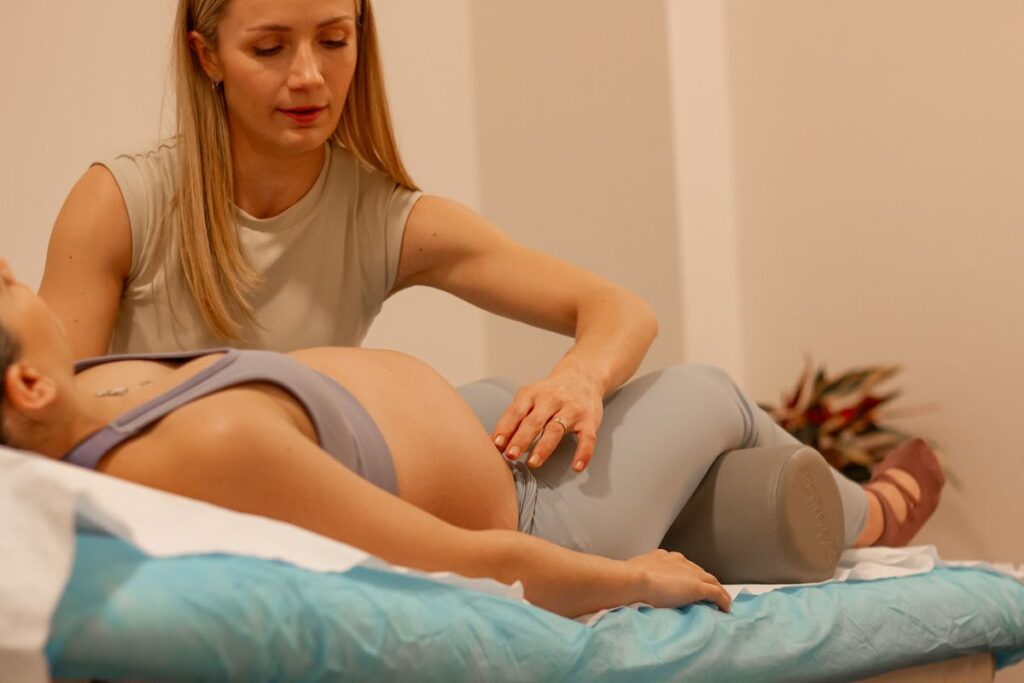
It’s advisable for your first perineal massage to be done by a professional (a midwife or a physiotherapist specializing in gynecology), since the condition of your muscles should be examined first.
In cases of pelvic floor hypertonia, the massage should be a little firmer (a stronger, longer stretch).
In cases of urinary incontinence during pregnancy, this massage can be combined with pelvic floor muscle contractions.
After that, the woman continues at home and can do it daily (or at least 3 times a week). Sometimes, because of the size of the bump, it’s uncomfortable to do it alone, so in that case it can be done with your partner.
We recommend that the pregnant woman come to the first appointment with the physiotherapist or midwife together with her partner, so they can both learn how to do it.
How to prepare a comfortable session
We insist that it’s very important to have done it before with guidance. See a professional who knows how to do these steps and who can help you understand which sensations are the right ones.
For those who already have experience and practice:
- The right time and place: This is a moment for you and your baby. Find a corner of your home where no one will disturb you and where you feel relaxed. I recommend doing the massage after a hot shower, which will relax your whole body.
- Position: Ideally, sit on the floor (on a towel or a pillow), with your back against the wall and your legs apart. Another very comfortable position is standing, with one leg resting on a stool. You can massage with your thumbs or with your index and middle fingers.
- Hygiene: Clean hands, short nails.
- Lubricant: Vegetable oil (rosehip is the special oil for this type of massage and has moisturizing properties), avocado oil or aloe vera. You’ll find them in health food stores or pharmacies.
Perineal massage step by step
External perineal massage
This involves massaging the outside of the vagina.
- Start in the area between the anus and the vagina, a very sensitive area that is prone to tearing.
- From there, move upward on both sides, always avoiding the urethra.
- You can do the external massage without lubricant at first, to stretch the tissue well, and then with oil to moisturize the area.
Internal perineal massage
This involves stretching the vaginal walls and making them more flexible.
- Insert two oiled fingers (index and middle) about 3–4 cm (1½ inches) into the vagina.
- Place them in the center, at the bottom, and press toward the anus.
- Hold the pressure for about 10 seconds and then slowly release the stretch.
- Repeat 3 times.
- Then move your fingers to one side. Press toward that side and slightly toward the anus, as if you wanted to open the vaginal wall.
- The pressure should always be toward the anus (because that’s the area where the cut is usually made during birth).
- Hold the pressure for 10 seconds and try to relax the spot you’re pressing.
- Breathe very deeply and imagine the tissues gradually losing their tension.
- You’ll feel a burning or sometimes stinging sensation. It’s similar to the feeling when the baby’s head is coming out.
- Repeat the same stretch on the other side, taking care not to move toward the urethra. It should be a U-shaped stretch.
Should I continue perineal massage postpartum?
If you had a vaginal birth and an episiotomy, yes. After a deep episiotomy or a large tear, there’s a scar that sometimes causes discomfort in the perineum.
It’s a scar like any other on your body: hard, inelastic tissue that causes adhesions and pulls on the surrounding tissues.
An episiotomy scar can be the cause of chronic pelvic pain. It can also cause pain when you urinate, discomfort during sex or reduced sensation in the pelvic floor.
Before doing it, you should see a physiotherapist for an assessment. Wait until the stitches have come out and until she confirms there are no contraindications.
The same type of stretches are done, but in this case mainly on the scar area. At first it will feel painful and uncomfortable, but it’s one of the best techniques for recovering the function and strength of the pelvic floor muscles. You can also try other pelvic floor exercises.


Learn perineal massage in Valencia
We teach it to you step by step in our birth preparation. Can’t come to Valencia? We also see you in an online consultation.