The Kegel method and the best Pilates exercises to strengthen the pelvic floor



Article content
Which of us hasn’t heard or read at some point about Kegel exercises and the Kegel method, how beneficial they are, and tried doing them at home? When something becomes trendy, misinformation about it also grows, which is why there may be incorrect content online. That’s why we’ve prepared this article on the best pelvic floor exercises based on the Kegel method.

History of the Kegel method for women
As we’ve mentioned more than once, awareness of the need to look after the pelvic floor is more common today. But in the past, thousands of women suffered in silence from conditions caused by poorly trained pelvic muscles.
The Kegel method for women is one of the oldest exercise routines focused on working the pelvic floor, and also one of the most recommended by gynecologists.
It’s no coincidence that Harvard University recently included the Kegel method as one of the five most recommended physical activities for the human body.
The Kegel method for women is trendy
In my experience as a physiotherapist specializing in the pelvic floor, I often see women who get carried away by the “fame” of this method, or who have been advised to follow the Kegel method without first having an assessment of the condition of their pelvic floor.
It’s crucial that a qualified professional decides whether these exercises are suitable for the woman, since there may be cases where they’re contraindicated.
So what is the Kegel method for women based on, and when can we do it? Can Kegel exercises be done during pregnancy? Is it OK to contract the Kegel muscles while urinating? And how long should the contraction last? These are some of the frequently asked questions we’ll answer in this article, where we take an in-depth look at training based on the Kegel method.
What are exercises based on the Kegel method?
Exercises based on the Kegel method are voluntary pelvic floor contraction exercises. A voluntary contraction is a muscle action we do consciously.
They involve contracting the muscles that close the sphincters of the urethra and rectum and the muscles that support the internal organs of the pelvis. The most noticeable contraction is that of the pubococcygeus muscle, which is in the middle of the perineum. Using Kegel balls boosts the work and results of the Kegel method.
How do women do Kegel exercises?
The most common example used to explain them is to imagine you want to stop the flow of urine, because that way you’ll be contracting these muscles and closing the sphincters. Another example is to imagine you want to hold in gas or close your vagina or anus.
The important thing is to feel only the activation of the deep pelvic muscles, without activating the superficial muscles, that is, the glutes, inner thighs or quadriceps.
Is it a good idea to use the Kegel method while urinating?
Doing the Kegel method while urinating is not recommended, as stopping the flow of urine can cause a urinary tract infection and change the physiology of urination. Normally, the muscles relax when we urinate or have a bowel movement. Contraction is for holding in urine, gas and/or stool.
What position should you do Kegel exercises in?
Postpartum, when the pelvic floor is very weak or damaged by episiotomies or tears, it’s recommended to follow the Kegel method in horizontal positions (lying down). In upright positions (sitting or standing), pressure inside the abdominal cavity increases and it’s harder to contract and lift the pelvic floor muscles.
The Kegel method for women postpartum
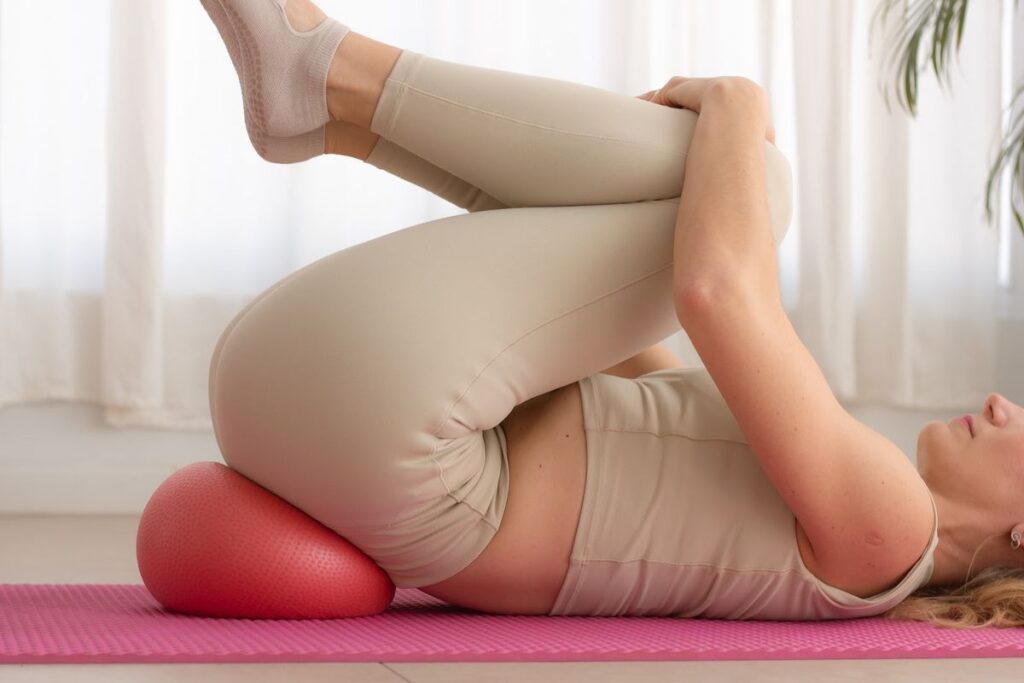
Steps to follow the Kegel method postpartum:
- Lie on your back (flat, as in the image), with your legs bent and your feet on the floor.
- Place your pelvis in neutral: in this position, your sacrum should rest on the floor, with the natural curve of your lower back and your hip bones level.
- Take a deep breath and, as you let it out, contract your pelvic floor muscles and lift them up (toward your breastbone).
- Remember to contract while you breathe out, not while holding your breath.
- Hold the contraction for 5 seconds and relax for another 5 seconds.

The Kegel method if you’re not postpartum
If you’re not postpartum and want to add Kegel exercises to your daily training routine, or want to improve the strength of your pelvic floor because you have urinary incontinence or any other gynecological dysfunction, the best option is to do advanced Kegel exercises.
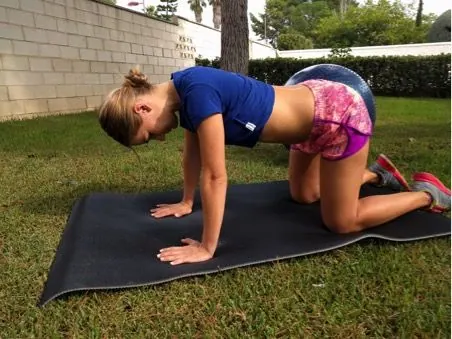
The technical guidelines are similar to the ones above, but other positions are added. For example, in these Kegel exercises we can sit on a fitball, stand with our trunk leaning forward, be on all fours, lie on our side, lie face down and more.
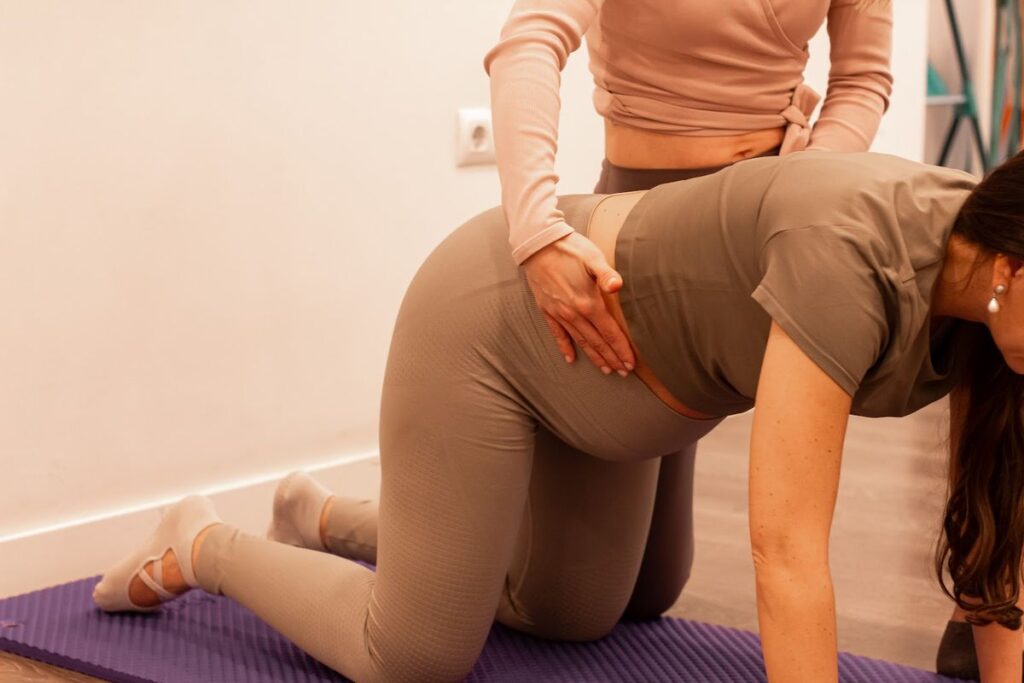
Kegel method on all fours
- Place your wrists under your shoulders and your knees under your hips so your spine and pelvis are in neutral.
- Take a deep breath and, as you breathe out, contract your pelvic floor and draw it toward your breastbone.
- It’s harder to activate in this position because gravity works against us, so we have to work harder to do the contractions correctly.
- The contraction lasts 5 seconds and the relaxation also 5 seconds.
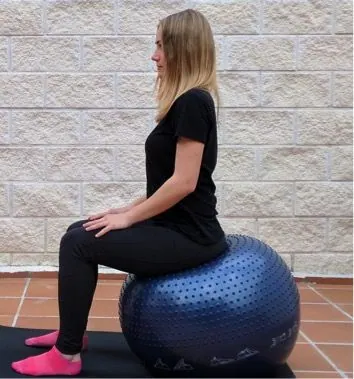
Kegel method for women sitting on a fitball
- Sitting on a large Pilates fitball, place your feet hip-width apart and rest your hands on your thighs so you don’t tense your shoulders.
- Lengthen your spine upward (as if you wanted to grow taller) and place your pelvis in neutral (feel your sit bones and perineum resting on the ball).
- Take a deep breath and, as you breathe out, contract your pelvic floor and lift it. Imagine your pelvic floor is an elevator: close the doors and then take it up to the level of your belly button.
- The contraction lasts 5 seconds and the relaxation another 5 seconds.
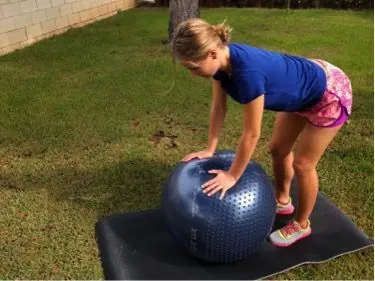
Kegel method standing with the trunk leaning forward
- This position requires good control of the postural muscles, as you need to keep your balance and your spine lengthened.
- Stand with your ankles hip-width apart and bend your knees slightly.
- Lean your trunk forward, keeping the curve of your lower back (bending at the hips, not the lower back).
- Rest your palms on the large ball (if you don’t have a ball, rest your hands on a tall chair).
- Take a deep breath and, as you let it out, contract your pelvic floor and draw it toward your breastbone. Hold the contraction for 5 seconds and relax for another 5 seconds.
What technical guidelines should I follow when doing Kegels?
To get the most out of the Kegel method, do the exercises avoiding the common mistakes below and following our advice. The general technical guidelines for Kegel exercises are:
- Submaximal contraction strength: always activate your pelvic floor with 80% of your maximum strength (submaximal strength), never 100%. Submaximal contractions are enough and won’t trigger a reflex contraction of the rectus abdominis.
- Contract as you breathe out and relax as you breathe in.
- Remember the relaxation time: if you activate the muscles for 5 seconds, relaxation should last just as long.
- Medium speed: always in sync with your natural breathing.
- Correct posture: always keep your pelvis in neutral and your spine lengthened.
- Make time for yourself: the Kegel method requires space, time, concentration and privacy. Doing them anywhere, like in the car, at a bus stop or sitting at work, makes it more likely you’ll do them in the wrong posture, so they’ll be less effective.
- Consistency: like any other exercise, the Kegel method needs to become part of our routine.
When shouldn’t you do Kegel exercises?
Having an initial pelvic floor assessment with a specialized physiotherapist before starting exercises based on the Kegel method is the best approach.
This is especially true for pregnant women, postpartum patients and women who feel this area is weaker or who leak urine.
In addition, in some dysfunctions Kegel exercises may not be recommended, or may even be harmful. We shouldn’t do them if we have:
- Vaginismus
- Dyspareunia
- Chronic pelvic pain
- Pelvic floor hypertonia
- Painful scars on the perineum


Get your pelvic floor checked in Valencia
Something doesn’t have to go wrong: with a pelvic floor check-up we see how it is and what you should do. Can’t come to Valencia? We also see patients in an online consultation.